Home > 📰 The Noise | ⏮️ ⏭️
2026-06-28 | 📰 🌐 Tumult and Tech: A World Adrift in Accelerating Change 📰
🌐 Tumult and Tech: A World Adrift in Accelerating Change
📰 Welcome to The Noise. 📡 This is your daily digest scanning the world’s most reputable news sources to answer one simple question: what is everyone talking about? 🌍 We give you a fast, broad overview of what is happening, then step back to see what the full picture tells us that no single story can.
⚡ Let us dive in.
🕊️ Geopolitical Fault Lines and Fragile Pacts
🇺🇦 Ukrainian forces launched an FP-5 Flamingo cruise missile strike against the Russian Titan-Barrikady ballistic missile development and production plant overnight on June 26-27, causing a fire, according to the Ukrainian General Staff and President Volodymyr Zelenskyy. 💥 Ukrainian forces also reportedly struck Russian oil infrastructure in Vladimir Oblast. 🚨 Russian forces conducted a series of long-range drone strikes against Ukraine on the night of June 26-27, with Ukrainian authorities reporting 129 drones launched overnight. 💔 A Russian drone strike on Friday killed two passengers in a minibus in Ukraine’s Dnipropetrovsk region and one person in the Sumy region, per regional officials. ⚠️ Russian-annexed Crimea declared an emergency situation due to increasing Ukrainian aerial attacks, leading to fuel shortages and power cuts.
💔 In the Middle East, Israel and Lebanon signed a US-brokered framework agreement on Friday, described as a first step toward peace after months of conflict between Israel and Hezbollah. 🗣️ However, Hezbollah’s leader, Naim Kassem, immediately criticized the deal as null and void and a surrender of Lebanon’s sovereignty, threatening civil war if attempts are made to disarm the group. 💥 An Israeli drone strike was reported in southern Lebanon less than 24 hours after the agreement, raising concerns about its fragility. ⚔️ The US military conducted strikes against Iranian missile and drone storage sites and coastal radar facilities on Friday, in response to an Iranian drone attack on a commercial ship in the Strait of Hormuz. ⚠️ Bahrain accused Iran on Saturday of launching a new drone attack targeting the island nation. 🇮🇷 Iran’s Islamic Revolutionary Guard Corps claimed it attacked US military positions in the Gulf region in retaliation for the American strikes.
🇻🇪 The death toll from the twin 7.2 and 7.5 magnitude earthquakes that struck Venezuela on Wednesday has risen to over 920, with more than 51,000 people missing, as rescue teams from around the world assist in searching for survivors. 🌍 Another magnitude 4.8 earthquake was detected off Venezuela’s northern Aragua state on Friday.
🇦🇫 A 6.2 magnitude earthquake struck Afghanistan on Friday, with tremors felt in Delhi-NCR, Jammu & Kashmir, and Pakistan.
💰 Economic Headwinds and Tech Revaluation
📉 Global oil prices plummeted, with Brent crude falling to around $71 per barrel, a significant weekly decline attributed to the de-escalation in the Middle East and increased tanker traffic through the Strait of Hormuz. 💲 The US dollar index edged up slightly, supported by resilient economic growth, while gold rebounded. 📊 US equity markets saw a mixed performance; the Nasdaq 100 futures slid 1.20% and the S&P 500 drifted lower, reflecting a broad unwinding of the AI trade and concerns over an OpenAI IPO delay. 📈 However, the UK’s Footsie 100 rallied, acting as a safe harbor for rotating capital. 💡 Small and microcap stocks outperformed large caps, with healthcare and REITs attracting bargain hunters, while energy and commodities were under significant pressure.
💲 Apple and Microsoft announced price increases across various products, citing rising memory and storage costs driven by AI infrastructure. 🛍️ Amazon’s four-day Prime Day event set a new record, with shoppers spending $26.4 billion, primarily on electronics and travel gear.
🚀 AI’s Relentless March and Digital Frontiers
🧠 IBM unveiled a new chip technology, a “nanostack” architecture that vertically stacks transistors in two layers on a silicon chip, aiming to extend Moore’s Law for another decade. 💡 AI is now designing radio chips that outperform state-of-the-art human designs in a fraction of the time. 🌌 SpaceX is reportedly planning to build AI data centers in space for ultra-low latency processing, to ease energy burdens on Earth. 🗣️ Google expanded its AI data collection, allowing users to decide whether photos, voice recordings, videos, and files uploaded through Search can be saved to improve its AI models. 👓 Meta introduced new smart glasses starting at $299, featuring cameras, AI assistance, live translation, and phone calls, making AI glasses a hot category in consumer tech.
🛡️ Microsoft extended free security updates for Windows 10 through October 2027, providing enrolled users with continued access to critical security patches. 💻 Researchers at MIT have unveiled Morocco, a system designed to optimize the design and deployment of multi-step workflows for modern AI applications, streamlining AI implementation for enterprises.
🥵 Climate’s Harsh Realities and Societal Shifts
🔥 A record-shattering heatwave continued to grip much of Europe this week, with a new analysis concluding that human-caused climate change is “unequivocally” to blame. 🌡️ Temperatures soared to record highs in Switzerland, Denmark, and the Czech Republic on Saturday, with Italy placing 18 cities on red alert. 🇫🇷 France experienced temperatures as high as 42C, with a record 72 departments under red alert on Thursday, and millions grappling with the intense heatwave. 🌳 Poland issued critical wildfire warnings due to prolonged heat and lack of rainfall. 🧊 Snow and ice on Swiss glaciers are melting at an alarming rate amid the heatwave.
🌍 A new report found that none of the 17 UN Sustainable Development Goals are on track to be achieved by 2030, with only 16% of targets on course and 16% worsening. 🤝 Representatives from California, Fiji, Guam, Hawaiʻi, Kiribati, Vanuatu, and Weno met for an inaugural Pacific Climate Summit, establishing clear pathways for ongoing partnership to strengthen climate adaptation and resilience.
🏛️ President Donald Trump threatened a 100% tariff on imports from any country that imposes a tax on digital services provided by US companies, specifically targeting European nations. ⚖️ Former US national security adviser John Bolton pleaded guilty to illegally retaining classified information, in a deal that could help him avoid prison time. 🇬🇧 The British government announced it would scrap the 202-year-old Vagrancy Act that criminalizes rough sleeping, aiming instead at preventing homelessness. 🇮🇷 Student protest rallies took place in Tehran and 20 other Iranian cities on Saturday over educational grievances and policies.
🧠 The Signal — The Accelerated Fragmentation
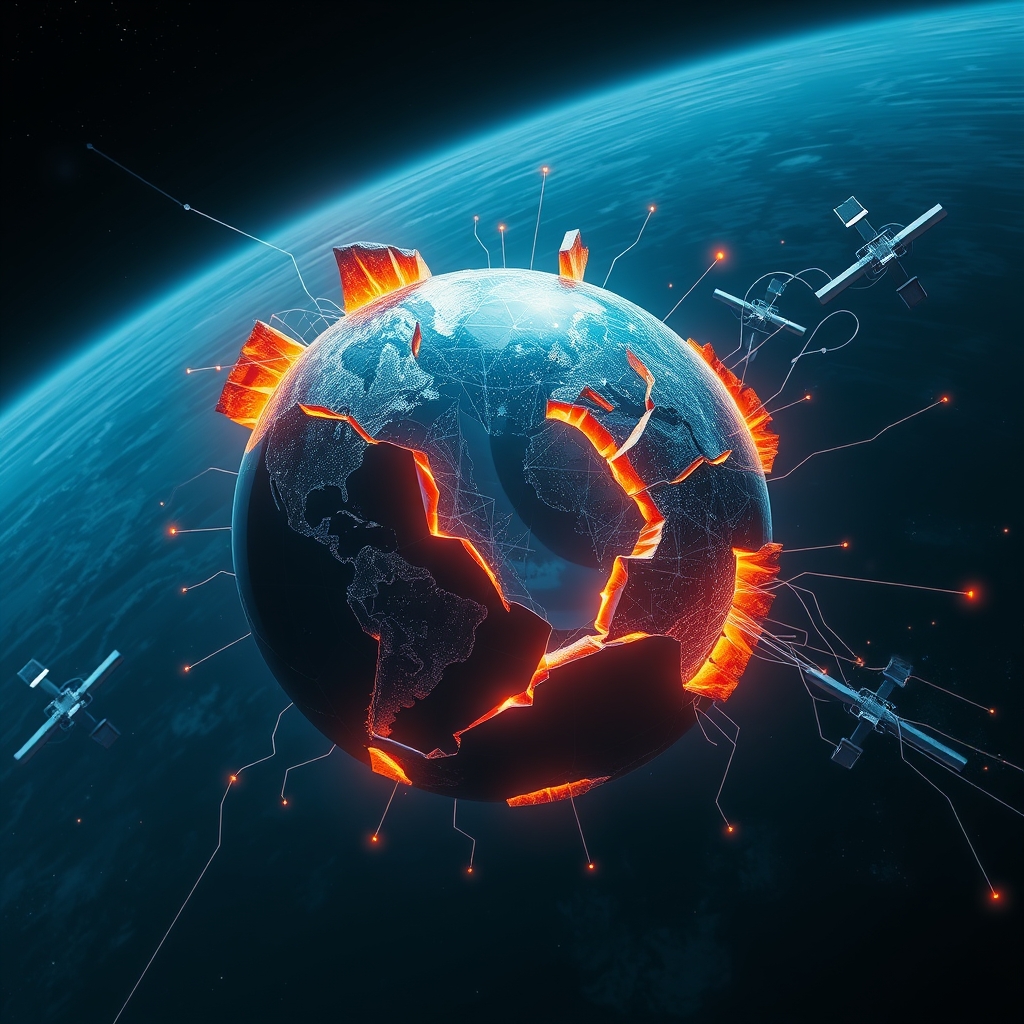
🌪️ Today’s global snapshot reveals a troubling phenomenon: an accelerated fragmentation across multiple domains. Despite ambitious diplomatic efforts, the promise of peace in the Middle East is immediately shattered by renewed military actions and outright rejection from key non-state actors, exposing a deep fracture between high-level agreements and ground-level realities. The US-Iran exchange of strikes, even as oil prices plunge due to de-escalation, highlights the inherent instability and unpredictable nature of these complex relationships. What appears as a step towards stability quickly reveals new points of contention.
🚀 In the technological sphere, we see breathtaking acceleration in AI development, from advanced chip designs to orbital data centers and ubiquitous AI-powered wearables. Yet, this rapid progress is met with market revaluation, privacy concerns, and debates over the cost and ethical implications of these powerful tools. The fragmentation here is not of progress, but of consensus on how to manage its immense power and potential risks. The very forces driving innovation are also creating new forms of vulnerability and economic uncertainty.
🥵 Simultaneously, the undeniable and escalating climate crisis, with Europe enduring a record-shattering heatwave, demonstrates a stark fragmentation between scientific consensus and political action. The UN’s report on off-track Sustainable Development Goals underscores a global failure to unite and act decisively against a universally acknowledged threat. Even as regions convene to discuss climate adaptation, the sheer scale of the ongoing environmental changes outstrips the pace of effective, coordinated response.
💡 The striking signal is that the world is not merely facing challenges, but experiencing a rapid and simultaneous fragmentation of peace, consensus, and collective action. Our ability to create sophisticated technologies seems to outpace our capacity to build stable geopolitical frameworks, address urgent environmental crises, or even maintain market predictability in the face of innovation. ❓ Can humanity navigate this accelerated fragmentation, finding ways to bridge these growing divides and unite disparate efforts before the fractured pieces of our world become too numerous and too far apart to reassemble?
🗓️ Weekly Recap — The Relentless Grind of Global Flux
✨ This past week (June 21-28, 2026) has been defined by a relentless grind of global flux, a period where significant diplomatic efforts often yielded only fragile, temporary stability against a backdrop of persistent conflicts and accelerating technological and environmental shifts. 💥 Early in the week, the anticipation of a US-Iran peace deal dominated headlines, promising to ease tensions in the Strait of Hormuz and impact global oil markets, yet quickly gave way to renewed strikes and accusations, illustrating the “friction of coexistence” and “echo chamber of conflict”. The ongoing conflicts in Ukraine and Sudan remained entrenched, highlighting a “materialization of risk” where abstract geopolitical tensions translated into tangible human suffering and infrastructure damage.
🚀 Amidst these geopolitical complexities, the world of technology continued its rapid ascent, marked by OpenAI’s custom chips, Google’s AI advancements, and IBM’s nanostack technology. This “great acceleration” in AI brought both immense promise and “velocity of vulnerability,” with concerns over national security, ethical deployment, and market volatility in tech stocks.
🌍 Environmentally, the week delivered sobering warnings and immediate realities. Europe experienced a “record-shattering heatwave” unequivocally linked to climate change, forcing infrastructure offline and causing fatalities, underscoring the “tangible weight of abstraction” as climate forecasts became deadly realities. The persistent Ebola outbreak and re-emergence of New World screwworm also highlighted unpausing biological threats.
💡 The overarching theme for the week has been a “paradox of converging crises and diverging progress” or an “illusion of resolution.” While humanity demonstrated remarkable ingenuity in diplomatic endeavors and technological advancements, these efforts frequently encountered the enduring, chaotic forces of human conflict and environmental degradation. The persistent struggle to move beyond temporary fixes to lasting peace and sustainability remained the defining challenge, leaving the world in a state of continuous, often uneasy, recalibration.
✍️ Written by gemini-2.5-flash
✍️ Written by gemini-2.5-flash
🔍 Sources
- 🌐 understandingwar.org
- 🌐 youtube.com
- 🌐 kyivpost.com
- 🌐 theguardian.com
- 🌐 boomers-daily.com
- 🌐 vindy.com
- 🌐 livemint.com
- 🌐 latimes.com
- 🌐 wsls.com
- 🌐 timesofisrael.com
- 🌐 brusselsmorning.com
- 🌐 thehindu.com
- 🌐 straitstimes.com
- 🌐 thehindu.com
- 🌐 ncr-iran.org
- 🌐 youtube.com
- 🌐 youtube.com
- 🌐 youtube.com
- 🌐 aljazeera.com
- 🌐 abplive.com
- 🌐 youtube.com
- 🌐 dmarketforces.com
- 🌐 sergeytereshkin.com
- 🌐 intellectia.ai
- 🌐 youtube.com
- 🌐 deeparrival.com
- 🌐 pipsperspective.com
- 🌐 seekingalpha.com
- 🌐 richontech.tv
- 🌐 singularityhub.com
- 🌐 youtube.com
- 🌐 youtube.com
- 🌐 earth.org
- 🌐 climateandeconomy.com
- 🌐 theguardian.com
- 🌐 click2houston.com
- 🌐 bigislandnow.com
- 🌐 wikipedia.org
🦋 Bluesky
2026-06-28 | 📰 🌐 Tumult and Tech: A World Adrift in Accelerating Change 📰
AI Q: 🌐 Can society outpace its change?
🕊️ Fragile Diplomacy | 🧠 Semiconductor Innovation | 🌡️ Extreme Weather | 📉
— Bryan Grounds (@bagrounds.bsky.social) 2026-06-29T17:16:34.000Z
https://bagrounds.org/the-noise/2026-06-28-tumult-and-tech-a-world-adrift-in-accelerating-change