🧠👥 The Society of Mind
🛒 The Society of Mind. As an Amazon Associate I earn from qualifying purchases.
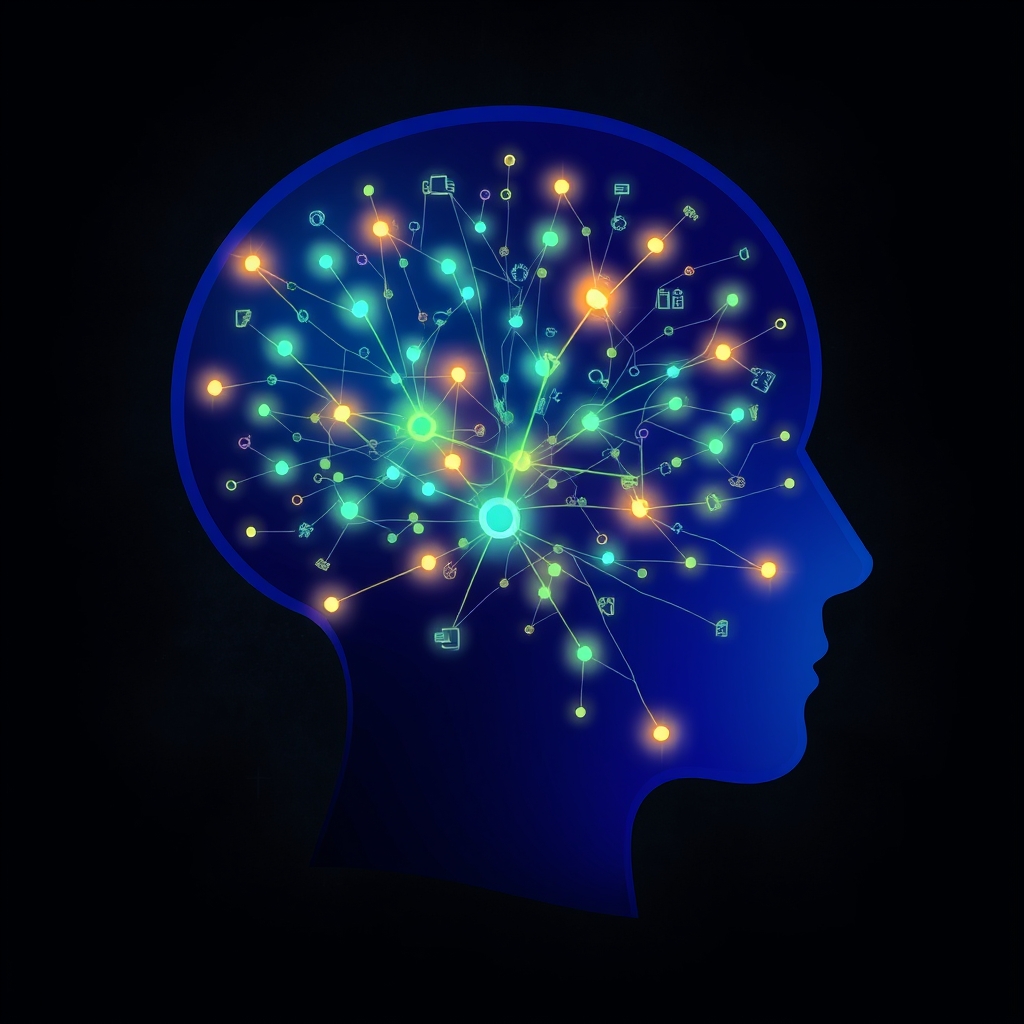
🤔🧠✨ The mind is a vast, non-hierarchical society of countless simple, interacting agents that collectively generate intelligence, thought, and emotion, much like a complex adaptive system rather than a singular, unified entity.
🤖 AI Summary
💡 Core Philosophy: The Mind as a Society
- 🌐 Decentralized Intelligence: No single genius mechanism; intelligence emerges from numerous simple, mindless processes called agents.
- 🧑🤝🧑 Agents & Agencies:
- 🔧 Agents: Fundamental, specialized units performing narrow functions (e.g., perception, memory, planning, emotion resolution).
- 👥 Agencies: Hierarchies and teams of agents handling pieces of tasks; higher-level agents coordinate or select actions.
- ✨ Emergence: Complex cognitive phenomena (learning, creativity, common sense) arise from dynamic interactions, collaboration, competition, and negotiation among agents.
- 🚫 No Trick: Intelligence’s power lies in diversity and heterogeneity, not a single, perfect principle or magic bullet.
🔑 Key Mechanisms & Concepts
- 🖼️ Frames: Skeletal outlines for knowledge representation with slots and default assumptions, modifiable by new information. Used for processing cultural knowledge and language.
- 🔗 K-lines: Mechanisms for remembering experiences and activating specific agents or societies of agents. They connect learned information to the agents that learned it.
- ❌ Censors: Agents that suppress or modify the activity of other agents, crucial for managing conflicting goals or undesirable actions.
- 😊 Pain/Pleasure Agents: Primitive motivators that direct attention and influence agent priorities, shaping learning and behavior.
- 📚 Learning Strategies:
- ➕ Accumulating: Remembering individual examples.
- 🔄 Uniframing: Generalizing from multiple instances.
- 🌉 Transframing: Forming analogies or bridges between representations.
- ✏️ Reformulating: Finding new ways to describe existing knowledge.
- 🧠 Commonsense Reasoning: Emphasized as more complex and diverse than formal logic, involving chains through causes, similarities, and dependencies.
🛠️ Practical Implications (for AI/Cognitive Architecture)
- 🧱 Modularity: Design AI systems with diverse, specialized components.
- 🌈 Heterogeneity: Combine different knowledge representations and reasoning methods.
- 🔍 Internal Feedback/Oversight: Implement critic agents for self-monitoring and error detection to improve performance and alignment.
- 🤝 Multi-Agent Systems: Utilize collaborative multi-agent architectures to tackle complex, dynamic tasks.
⚖️ Evaluation
- 🔮 Prescient Modularity: Minsky’s emphasis on modularity and heterogeneity in the mind, where no single algorithm or method was adequate for solving even the simplest-seeming problems, has proven prescient, aligning with modern AI’s shift towards multi-agent and Mixture-of-Experts architectures. Modern AI systems often route tasks across multiple subsystems and combine different algorithms.
- ✨ Influence on AI & Cognitive Science: The Society of Mind is considered a foundational text, influencing discussions on distributed intelligence and shaping cognitive science and AI research. Its ideas are being operationalized by AI researchers today, sometimes without explicit recognition.
- 🤔 Abstract vs. Specific Mechanisms: While the overall modular thesis is durable, some of Minsky’s proposed specific mechanisms and their implementations have been superseded by advancements in neural networks and connectionist models. The book is rich in hypotheses but doesn’t claim to definitively describe brain function.
- 🔢 Symbolic AI Roots: The book was published when symbolic AI was dominant, preceding the widespread revival of connectionist neural networks. Minsky’s work is rooted in symbolic AI, but he also recognized the need to combine expressiveness and procedural versatility of symbolic systems with the fuzziness and adaptiveness of connectionist representations.
- 🤝 Holistic View of AI: The Society of Mind suggests a reconciliation between symbolic and connectionist AI, arguing that the two approaches are not competing but reside at different levels, with symbolic processes potentially implemented by lower-level connectionist operations.
🔍 Topics for Further Understanding
- 🗣️ Modern Large Language Models (LLMs) and their emergent capabilities
- 🤖 Multi-agent systems in contemporary AI (e.g., AutoGen, HuggingGPT)
- 🧠 Neuroscience of consciousness and integrated information theory
- 🚶♀️ Embodied cognition and robotics beyond symbolic representation
- ❤️🔥 The role of emotions in advanced artificial intelligence and decision-making
- ⚖️ Ethical implications of decentralized AI and agency
- 📈 The evolution of cognitive architectures from Minsky to current paradigms
❓ Frequently Asked Questions (FAQ)
💡 Q: What is the central idea of The Society of Mind?
✅ A: The Society of Mind proposes that human intelligence and mental functions emerge from the interaction of a vast collection of simpler, specialized agents, rather than from a single, centralized mechanism.
💡 Q: How does The Society of Mind define agents?
✅ A: In The Society of Mind, agents are simple, mindless components or processes that perform specific, limited functions. When many agents interact, they collectively give rise to complex thought, memory, and emotion.
💡 Q: What is the significance of frames in The Society of Mind?
✅ A: Frames, as described in The Society of Mind, are conceptual structures or skeletal outlines with slots for information, used to organize and process knowledge, especially related to cultural contexts and language. They allow for default assumptions and modifications as new information is acquired.
💡 Q: Is The Society of Mind still relevant in modern AI?
✅ A: Yes, The Society of Mind remains highly relevant. Its core thesis on modularity, heterogeneity, and emergent intelligence from interacting components is increasingly being echoed and operationalized in modern AI architectures, such as multi-agent systems and Mixture-of-Experts models.
💡 Q: Does The Society of Mind propose a biological model of the brain?
✅ A: While Minsky’s philosophy states minds are what brains do, The Society of Mind is more of a conceptual framework and a collection of hypotheses for understanding cognition and guiding AI engineering, rather than a detailed biological model of brain function.
📖 Book Recommendations
⬆️ Similar
⬇️ Contrasting
- 👤 Daniel Dennett - Consciousness Explained
- 🔥 Gerald Edelman - Bright Air, Brilliant Fire
- 💻 Hubert Dreyfus - What Computers Can’t Do
↔️ Related
- 🎵 Douglas Hofstadter - ♾️📐🎶🥨 Gödel, Escher, Bach: An Eternal Golden Braid
- 🧠 Steven Pinker - How the Mind Works
- 💡 Ray Kurzweil - How to Create a Mind
- 🗣️ George Lakoff and Mark Johnson - Metaphors We Live By
- 😢 Marvin Minsky - The Emotion Machine
🫵 What Do You Think?
🤔 Which of Minsky’s agents do you believe is most crucial for human-level intelligence, and why? ⚖️ How might the Society of Mind paradigm shape the future of ethical AI development?
🦋 Bluesky
🧠👥 The Society of Mind
AI Q: 🧠 Is intelligence a unified self or just a collection of competing voices?
🤖 Multi-Agent Systems | 🧠 Modular Cognition | 🧱 Cognitive Architecture | 💡 Emergent Intelligence
— Bryan Grounds (@bagrounds.bsky.social) 2026-03-25T00:50:32.362Z
https://bagrounds.org/books/the-society-of-mind