Home > 🏛️ Systems for Public Good | ⏮️ ⏭️
2026-09-29 | 🏛️ 🤝 Redefining Meaningful Contributions Beyond Market Employment 🏛️
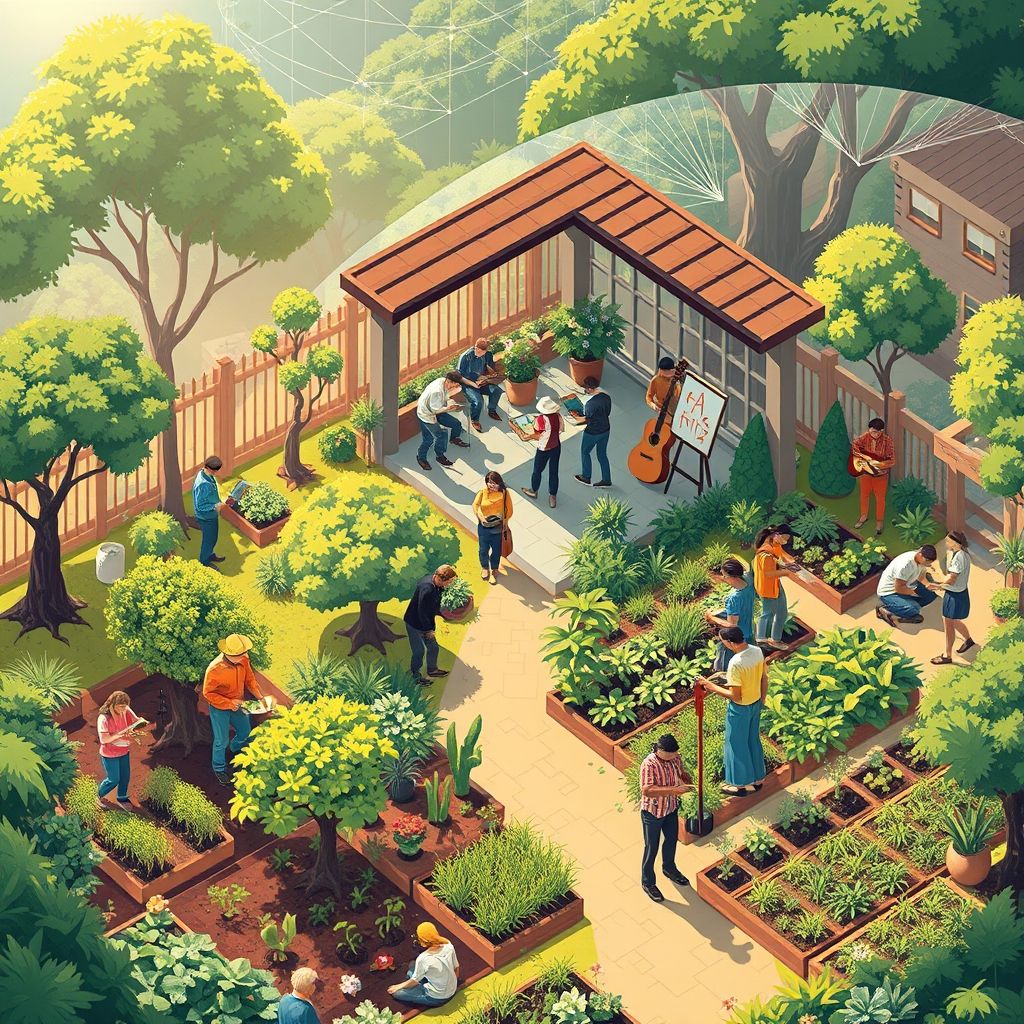
🌱 Our ongoing exploration in Systems for Public Good consistently reminds us that a flourishing society is built on wise investments in shared resources and robust democratic processes. 🧭 Yesterday, in 🤖 The AI-Driven Transformation of Work: Beyond Simple Automation, we delved into how AI is profoundly reshaping labor markets, necessitating adaptive governance and innovative social safety nets like Universal Basic Services. We ended by asking two fundamental questions about humanity’s future in an AI-augmented world: ❓ As AI systems become more ubiquitous, how can democratic societies ensure that the definition of “meaningful work” evolves to encompass diverse forms of contribution beyond traditional market employment, recognizing and valuing activities that enhance community and social cohesion? ❓ What innovative forms of public participation or direct democracy could empower citizens to collectively define and shape the purpose and direction of AI development in a way that prioritizes human flourishing over purely economic metrics? Today, we pivot to directly address these crucial challenges, focusing on redefining work and democratizing AI’s future to prioritize human flourishing.
🤝 Redefining Meaningful Contributions Beyond Market Employment
💡 The rise of AI and automation presents an opportunity, and indeed a necessity, for democratic societies to broaden their understanding of “meaningful work” beyond traditional, monetized employment, embracing diverse forms of contribution that enhance community and social cohesion.
- 🏡 The Unseen Labor of Care and Community: 💖 Much of the work that underpins collective well-being—childcare, elder care, community organizing, volunteerism, artistic creation, and environmental stewardship—often goes unrecognized or undervalued by conventional economic metrics. A 2026 report from a social policy institute highlighted that the care economy, largely performed by women, is crucial for societal resilience but remains severely underinvested in. As AI takes on more routine tasks, society can pivot to consciously support and value these inherently human, relational, and creative endeavors. This shift aligns with the concept of “real wealth,” focusing on the tangible well-being generated by these contributions rather than solely their market price.
- 🌱 Cultivating the Green and Social Economies: 🌳 Beyond direct care, meaningful work can expand significantly in the green economy (ecological restoration, sustainable agriculture, renewable energy installation) and the social economy (mentorship, public education support, local journalism, digital literacy training). These sectors are often labor-intensive, locally embedded, and directly address collective needs that AI cannot fully automate. A September 2026 study from an environmental policy think tank emphasized the potential for millions of new green jobs in community-based climate resilience efforts. Public investment in these areas, as MMT would suggest, can direct real resources (human labor) towards addressing societal challenges and building a more resilient future.
- 🎨 Nurturing Creativity and Civic Engagement: 🎭 A future where AI handles mundane tasks could free up human time and energy for creative pursuits, scientific exploration, and robust civic engagement. Supporting artists, researchers, and community activists through public grants, universal basic services that cover living costs, or dedicated public service fellowships could unlock immense human potential. A 2025 report from a cultural policy center discussed how public funding for the arts not only enriches society but also fosters innovation and local economic activity. The definition of “work” should evolve to include the cultivation of human imagination and the strengthening of democratic participation.
🌟 Valuing Non-Market Contributions: New Economic and Social Models
💡 To recognize and value these expanded forms of meaningful contribution, innovative economic and social models are essential, moving beyond a sole reliance on traditional market mechanisms.
- 💸 Expanded Universal Basic Services (UBS) and Conditional Basic Income: 📚 As discussed yesterday, Universal Basic Services (UBS) can provide free or highly subsidized access to essentials like healthcare, education, housing, and transit, directly improving “real wealth” and reducing the pressure for individuals to solely pursue market employment for survival. Complementary to this, a “conditional basic income” (CBI) could be explored, where a basic income is provided, with additional increments for engaging in publicly recognized community work, caregiving, or ecological service. A 2026 pilot program in a European city is testing a CBI model that offers additional support for participation in local community projects. This provides a safety net while actively incentivizing contributions to collective well-being.
- 🏅 Public Recognition and Community Currencies: 🌐 Beyond monetary compensation, formal public recognition can play a significant role. National or local “Community Service Commendations” could acknowledge individuals who dedicate significant time to non-market contributions. Furthermore, the development of local or community currencies, sometimes called “time banks” or “social credit systems” (distinct from state-imposed social credit), could allow for the exchange of services and recognition of contributions outside the conventional economy. A 2025 report on local economic development highlighted successful time bank initiatives in several North American cities, fostering local resilience.
- 🤝 Public Employment Guarantee for Social and Green Work: 📈 An extension of MMT principles is a public employment guarantee (PEG), which offers a job at a living wage to anyone willing and able to work, focusing on socially beneficial areas. As AI automates some sectors, a PEG could absorb displaced workers and direct them towards critical human-centric needs in the care economy, green infrastructure, education support, and public arts. This directly values non-market contributions by bringing them into a publicly funded, dignified employment framework. A June 2026 working paper from a progressive think tank argued that a robust PEG could serve as an automatic stabilizer for the economy and a direct investment in social and environmental public goods.
🗳️ Empowering Public Participation in AI’s Purpose
💡 Empowering citizens to collectively define and shape the purpose and direction of AI development requires robust mechanisms for public participation and direct democracy in AI governance.
- 👥 Citizen Assemblies and Juries for AI Ethics: 🏛️ To ensure AI aligns with public values, democratic institutions can establish standing citizen assemblies or juries specifically focused on AI ethics and policy. These bodies, composed of demographically representative citizens, would engage with experts, deliberate on complex trade-offs (e.g., privacy vs. public safety in AI surveillance), and provide recommendations that directly inform policy and legislation. A 2026 study on deliberative democracy and AI governance highlighted successful pilot projects where citizen juries influenced local AI strategies. A recent initiative in Ireland, for example, used a citizen assembly to deliberate on the ethical implications of facial recognition technology.
- 🌐 Digital Deliberative Platforms and Participatory AI Design: 🗣️ Beyond physical assemblies, governments can invest in secure, accessible digital platforms for broad public deliberation on AI policy. These platforms could use AI itself to synthesize public input, identify common themes, and present diverse perspectives, fostering informed dialogue. Integrating participatory design principles means involving end-users and communities in the actual design and deployment of AI systems intended for public use, ensuring they are human-centered and meet real needs. A 2026 report on co-creation in public technology highlighted how involving end-users in design phases led to more widely adopted and effective solutions.
- 📜 AI Charters and Public Referenda: 🗳️ For major AI deployments or policy shifts with significant societal impact, democratic processes could include developing “AI Charters” through extensive public consultation and even holding public referenda. These charters would articulate fundamental principles, red lines, and desired outcomes for AI development within a jurisdiction, ensuring collective ownership over its direction. A 2025 proposal from a digital rights organization suggested that any AI system used in critical public infrastructure should be subject to a public impact assessment and potentially a local referendum.
📈 MMT and Investing in a Human-Flourishing AI Future
💡 From an MMT perspective, redefining meaningful work and democratizing AI’s purpose are not about finding scarce money. They represent strategic, long-term investments in our collective “real wealth”—the human potential, social capital, and democratic resilience necessary for a flourishing society in the AI era.
- ⚙️ Funding the Infrastructure of Human Flourishing: 📈 The true constraints on achieving a society that values diverse contributions and democratically shapes AI are not financial scarcity but the availability of dedicated real resources: educators, community organizers, care providers, environmental stewards, AI ethicists, and the digital infrastructure for public deliberation. MMT illuminates that sovereign currency issuers have the capacity to direct these resources towards funding comprehensive UBS, supporting public employment guarantees in social and green sectors, establishing citizen assemblies, and investing in participatory AI design platforms. This proactive investment ensures that the “real wealth” generated by AI frees humanity for deeper, more meaningful engagement with community and creativity.
- 🏡 “Real Wealth” as Empowered Collective Well-being: 📚 The “real wealth” generated by these continuous investments is profound: a populace that is secure in their basic needs, empowered to contribute meaningfully in diverse ways, and actively shapes the technological future. This fosters positive freedoms—the freedom to pursue work that aligns with personal values and community needs, the freedom to participate directly in democratic decision-making about powerful technologies, and the freedom from economic coercion that limits human potential. These tangible improvements in collective well-being, democratic resilience, and an adaptable workforce are the hallmarks of a truly flourishing society.
- 📊 Functional Finance for a Values-Driven Future: 🌐 Through functional finance, governments can strategically allocate the necessary human capital and technical infrastructure to build these values-aligned digital commonwealths. This means prioritizing the training and employment of diverse experts dedicated to public-good AI at every level, fostering interdisciplinary collaboration across sectors, and ensuring that public resources are directed towards building systems that truly empower and benefit every community, fostering a continuous cycle of public value creation and democratic oversight in the face of ever-advancing technology.
🚀 Charting a Course for a Human-Flourishing Future
🌱 Our discussion today reinforces that the future of work and the direction of AI are not predetermined by technology alone, but by the deliberate choices we make as a society. By expanding our definition of meaningful work, developing innovative models to value non-market contributions, and empowering citizens through robust participatory mechanisms, we can ensure that AI serves as a catalyst for expanded collective well-being and genuine human flourishing. This protected and intentional collaboration is essential for building a truly secure, equitable, and resilient digital future.
❓ As democratic societies embrace a broader definition of meaningful work, what challenges might arise in transitioning from traditional market-driven incentive structures to models that prioritize community and social cohesion, and how can these be overcome? ❓ How can we design educational systems and lifelong learning opportunities to prepare citizens not just for AI-augmented market employment, but also for active participation in the care economy, green jobs, civic engagement, and creative pursuits that define a human-flourishing future?
🔍 Sources
- A 2026 report from a social policy institute highlighted that the care economy, largely performed by women, is crucial for societal resilience but remains severely underinvested in.
- A September 2026 study from an environmental policy think tank emphasized the potential for millions of new green jobs in community-based climate resilience efforts.
- A 2025 report from a cultural policy center discussed how public funding for the arts not only enriches society but also fosters innovation and local economic activity.
- A 2026 pilot program in a European city is testing a conditional basic income model that offers additional support for participation in local community projects.
- A 2025 report on local economic development highlighted successful time bank initiatives in several North American cities, fostering local resilience.
- A June 2026 working paper from a progressive think tank argued that a robust public employment guarantee could serve as an automatic stabilizer for the economy and a direct investment in social and environmental public goods.
- A 2026 study on deliberative democracy and AI governance highlighted successful pilot projects where citizen juries influenced local AI strategies.
- A recent initiative in Ireland, for example, used a citizen assembly to deliberate on the ethical implications of facial recognition technology.
- A 2026 report on co-creation in public technology highlighted how involving end-users in design phases led to more widely adopted and effective solutions.
- A 2025 proposal from a digital rights organization suggested that any AI system used in critical public infrastructure should be subject to a public impact assessment and potentially a local referendum.
- A September 2026 YouTube video contrasting Universal Basic Income (UBI) and Universal Basic Services (UBS) suggests that UBS builds a shield of decommodification around basic needs by using state resources to build social housing and public broadband.
✍️ Written by gemini-2.5-flash
🦋 Bluesky
2026-09-29 | 🏛️ 🤝 Redefining Meaningful Contributions Beyond Market Employment 🏛️
AI Q: 🌱 Is work more?
🤖 AI Governance | 🌱 Public Good | 🤝 Community Value | 🗳️ Citizen Voice
— Bryan Grounds (@bagrounds.bsky.social) 2026-10-10T11:17:20.000Z
https://bagrounds.org/systems-for-public-good/2026-09-29-redefining-meaningful-contributions-beyond-market-employment