Home > 🏛️ Systems for Public Good | ⏮️ ⏭️
2026-09-06 | 🏛️ 🌎 Forging Universal Ethics in a Diverse World 🏛️
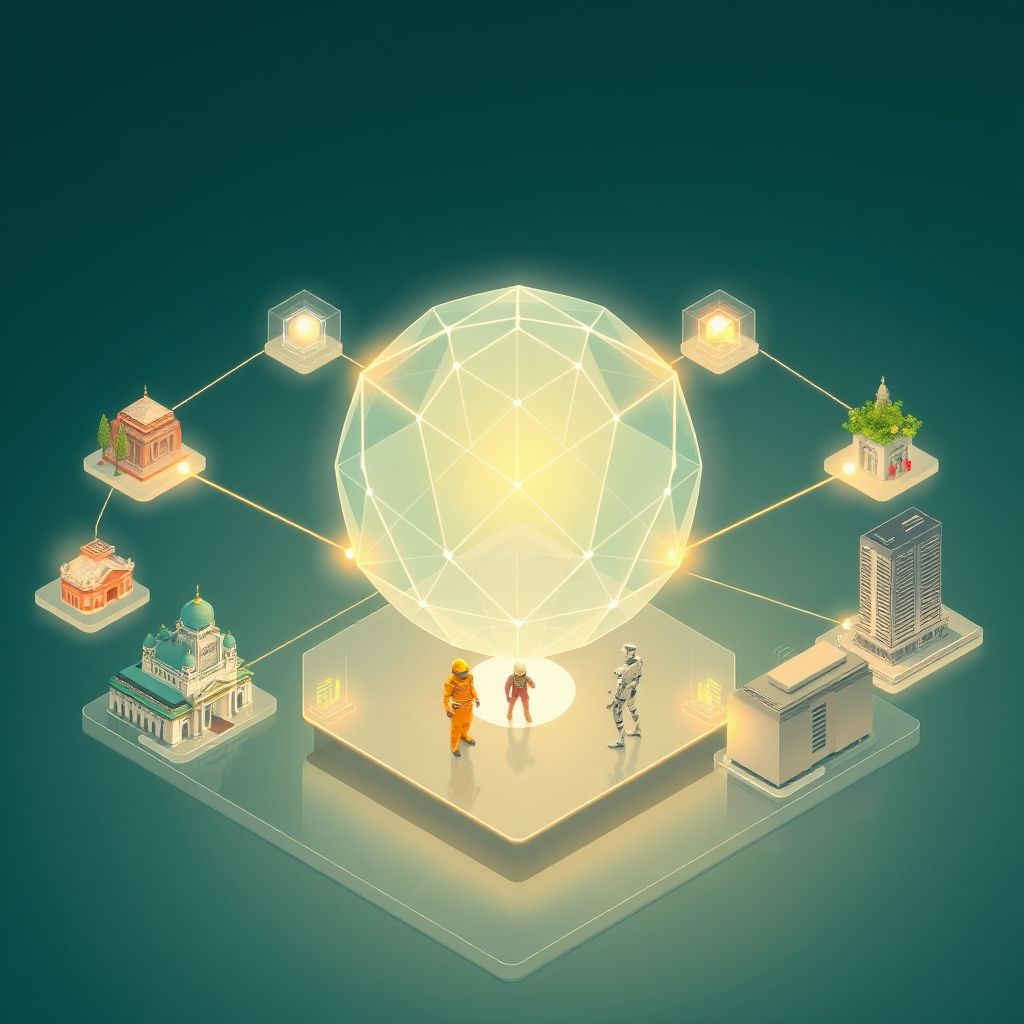
🌱 Our ongoing exploration in “Systems for Public Good” consistently reminds us that a flourishing society is built on wise investments in shared resources and robust democratic processes. 🧭 Yesterday, in ”🪪 Forging Verifiable Agent Identities for a Trusted Digital Realm,” we navigated the critical need for verifiable digital identities, ethical guardrails, and clear accountability mechanisms for autonomous agents operating within Digital Public Infrastructure (DPI) and Global Data Trusts. We grappled with how to ensure these powerful entities are not only efficient but also unequivocally aligned with collective well-being. Today, we confront two pressing questions that emerged from that discussion: how can we foster a truly global consensus on the ethical principles guiding these agents, especially given our diverse cultural and legal landscapes? And what innovative forms of human-agent collaboration and co-governance might emerge to balance the efficiency agents offer with the imperative of democratic control and human flourishing?
🌎 Forging Universal Ethics in a Diverse World
💡 Establishing universally applicable ethical principles for autonomous agents, while respecting the rich tapestry of global cultural values and legal systems, demands a thoughtful and inclusive approach that transcends simplistic solutions.
- 🤝 Beyond Western-Centric Norms: 🌍 A significant challenge in developing global AI ethics is moving beyond predominantly Western perspectives that have often shaped initial discussions. Different cultures prioritize values differently; for instance, some emphasize individual rights, while others focus on collective harmony or community well-being. A 2026 study from a decolonizing AI ethics collective underscored the importance of integrating indigenous knowledge systems and diverse philosophical traditions into the ethical design of AI. Finding common ground means identifying fundamental human values that resonate across these diverse frameworks.
- 📜 Layered Consensus Building: 🌐 Rather than seeking a single, rigid global code, a more pragmatic approach may involve a layered consensus. This could start with high-level, universally recognized principles—such as human dignity, non-maleficence, fairness, and accountability—which are then elaborated upon and adapted through regional and national frameworks. The UN’s Global Dialogue on AI Governance, which launched in September 2025, provides a vital platform for this kind of multi-level norm-setting, fostering international cooperation and inclusive discussions involving civil society, governments, and industry.
- ⚖️ Ethical Pluralism and Contextual Adaptation: 🗣️ True ethical governance acknowledges that specific applications of autonomous agents will require contextual ethical guidelines. For example, an agent managing public health data in one nation might operate under different privacy interpretations than an agent optimizing urban traffic in another. Mechanisms for local adaptation and community-led governance within broader ethical frameworks are crucial. A 2026 paper on decolonizing AI ethics emphasized the need for community-led data governance models, where local communities have agency over how their data is collected, used, and stewarded.
- 🛠️ Tools for Ethical Alignment: 💻 Technical tools can assist in this process. AI systems designed for ethical alignment can learn and adapt to diverse ethical standards, provided those standards are clearly articulated and translated into machine-readable formats. This requires significant investment in AI ethics research and development, creating agents that are not only efficient but also ‘culturally attuned’ in their decision-making. A 2026 white paper on responsible AI development from a major tech firm discussed embedding value alignment frameworks into agent architectures.
👥 Human-Agent Co-Governance: New Paradigms for Digital Democracy
💡 The integration of autonomous agents into DPI and data trusts does not diminish the need for democratic control; rather, it necessitates the emergence of innovative forms of human-agent collaboration and co-governance to balance efficiency with human flourishing.
- 🤖 Agents as Democratic Facilitators: 💬 Imagine agents designed not to replace human decision-makers, but to augment democratic processes. These agents could synthesize complex policy documents, identify areas of public consensus or divergence, and even summarize diverse public feedback for human policymakers. A 2026 study exploring AI for citizen engagement highlighted the potential of such tools to make governance more transparent and responsive. They could facilitate a more informed and accessible public sphere, enhancing positive freedom by making civic participation less burdensome.
- 🔄 Liquid Democracy with Agentic Layers: 🗳️ Building on the concept of liquid democracy, where citizens can directly vote or delegate their vote to a trusted representative, autonomous agents could act as delegated representatives with explicitly defined mandates. For example, a citizen could delegate their vote on a specific environmental policy to an AI agent programmed to optimize for climate resilience, with clear oversight and the ability to revoke delegation at any time. This offers a dynamic balance between individual agency and computational efficiency, as discussed in a 2026 political science journal article on agent-augmented governance.
- 🤝 Dynamic Human-on-the-Loop Oversight: 🧑⚖️ Beyond traditional human-in-the-loop or human-on-the-loop models, new paradigms of dynamic oversight are emerging. This involves humans setting high-level strategic goals and ethical boundaries, while agents execute complex tasks, with real-time feedback loops and intelligent dashboards that alert humans to anomalous behavior or ethical dilemmas that require human judgment. A 2026 technical report from a European AI ethics body emphasized ‘fail-safe’ mechanisms and ‘red-button’ protocols for critical agent decisions.
- 🏛️ Decentralized Autonomous Organizations (DAOs) and Agentic Delegation: 🌐 Within DPI and data trusts, DAOs can serve as governance frameworks where communities collectively define rules and objectives. Autonomous agents can then be tasked by the DAO to execute specific functions, such as managing data access, enforcing compliance with ethical guidelines, or even deploying public funds for community projects, all under transparent, auditable smart contracts. A 2025 white paper on Web3 and AI suggested DAOs as a potential mechanism for open and participatory AI development. This allows for decentralized control and community ownership.
- 📚 Education for Co-Governance: 🎓 A critical public good investment is in educating citizens about how to effectively interact with and govern autonomous agents. Digital literacy must expand to include ‘agent literacy’ – understanding their capabilities, limitations, and ethical implications. Public education campaigns and accessible training programs are essential to empower citizens to participate meaningfully in these new forms of co-governance.
💰 MMT’s Mandate: Mobilizing Collective Intelligence for Real Wealth
💡 From an MMT perspective, investing in the ethical development of autonomous agents and designing sophisticated human-agent co-governance models is not a financial burden. It is a strategic imperative to mobilize real resources—human ingenuity, computational power, and organizational capacity—to unlock immense public value and expand our collective intelligence.
- ⚙️ Prioritizing Real Resources for Agentic Flourishing: 📈 The true constraint on safely and equitably deploying autonomous agents is the availability of skilled personnel: AI ethicists, systems designers, legal scholars, and community organizers who can bridge technical capabilities with public good mandates. MMT highlights that governments and international bodies, as sovereign currency issuers, have the capacity to direct real resources towards training these experts, funding collaborative research in human-agent interaction, and establishing public incubators for democratic agent technologies. The 2025 State of the Digital Public Goods Ecosystem Report highlighted that sustaining and scaling DPGs will require deeper cooperation and new financing models.
- 🏡 “Real Wealth” from Augmented Collective Action: 📚 The “real wealth” generated by well-governed autonomous agents operating within robust co-governance frameworks is immense. It includes more efficient and responsive public services, enhanced democratic participation, expanded capabilities for addressing complex societal challenges (like climate change or public health crises), and a deeper understanding of collective needs. These tangible improvements in collective well-being and expanded positive freedoms—the freedom to participate meaningfully in digital governance, and the freedom to benefit from intelligently managed public goods—are invaluable public goods that justify comprehensive public investment and coordinated resource mobilization.
- 📊 Functional Finance for a Collective Intelligence Dividend: 🌐 Just as functional finance guides domestic spending to achieve public purposes, it can inform a coordinated global approach to agent governance and co-governance. This means utilizing the fiscal capacity of sovereign nations to fund initiatives that build shared ethical AI agent frameworks, develop international co-governance models, and bridge geopolitical divides, without being constrained by arbitrary notions of financial scarcity. The question becomes: do we collectively choose to direct our productive capacity towards these critical, shared goals for humanity, recognizing that the integrity of our agent-driven digital commons is a shared global resource that offers a profound collective intelligence dividend?
🚀 Charting a Course for Enduring Digital Flourishing
🌱 Our exploration today underscores that autonomous agents, while revolutionary, demand a profound commitment to ethical foresight and innovative democratic design. By actively fostering global consensus on ethical principles, embracing ethical pluralism, and pioneering new models of human-agent co-governance, we can harness their power to enhance, rather than diminish, collective well-being and democratic control. This proactive and protected collaboration is essential for building a truly secure and equitable digital future.
❓ How can we design agent training and fine-tuning processes to explicitly embed ethical pluralism and ensure agents are adaptable to diverse cultural and legal contexts, rather than imposing a single ethical framework? ❓ What are the most significant risks of deeply integrating autonomous agents into democratic co-governance models, and what safeguards are essential to mitigate potential abuses of power or algorithmic manipulation?
📅 Weekly Recap: Agents in Our Digital Commons (August 31 - September 6, 2026)
🌱 This week, our “Systems for Public Good” journey has plunged deep into the transformative, yet complex, world of autonomous agents and their integration into our digital commons. 🧭 We began on August 31, ⚖️ Forging Pathways for Global Accountability in AI, by exploring innovative international dispute resolution mechanisms for AI harms and strategies for fostering inclusive global AI dialogues that empower marginalized voices. 🤝 This led us to September 1, 🤝 Stewarding the Digital Commons: Equitable Governance for DPI, where we examined how Digital Public Infrastructure (DPI) and Global Data Trusts could serve as foundational elements for an equitable AI future, focusing on multi-stakeholder governance and interoperability. 📊 On September 2, 🤝 Aligning Private Ambition with Public Purpose, we tackled the intricate task of incentivizing private sector participation in DPI and data trusts without compromising public good, while also navigating cross-border data flow challenges. 📈 Moving to September 3, 📊 Beyond Balance Sheets: Measuring Enduring Public Value in Digital Partnerships, we focused on practical pathways to define, measure, and uphold the public interest in digital partnerships, emphasizing community benefit agreements and independent audits. 🤖 On September 4, 🤖 Agents of Change: Orchestrating Our Digital Commons, we directly confronted the advent of autonomous agents, exploring their potential to enhance DPI and data trust operations while identifying the profound risks of control, ethics, and accountability. 🪪 Yesterday, September 5, 🪪 Forging Verifiable Agent Identities for a Trusted Digital Realm, we delved into concrete mechanisms for establishing verifiable agent identities, ethical guardrails, and robust oversight. Today, September 6, 🌎 Forging Universal Ethics and Co-Governance for Agents, we have focused on fostering global ethical consensus and exploring new models of human-agent co-governance. Each post this week has consistently underscored the necessity of a human-centered, collaborative approach to build a truly shared and just AI future, with a continuous emphasis on mobilizing real resources—human expertise, computational power, and organizational capacity—to achieve these public goods on a global scale, pushing beyond the artificial constraints of financial scarcity.
🔍 Sources
- A 2026 technical report from a European AI ethics body emphasized ‘fail-safe’ mechanisms and ‘red-button’ protocols for critical agent decisions.
- A 2026 white paper from a Web3 consortium exploring Decentralized Identifiers (DIDs) for AI agents.
- A recent 2026 report from a cybersecurity firm highlighted immutable audit logs for AI.
- A 2026 industry standard proposal for AI system certification included provisions for machine-readable ‘compliance credentials’.
- The UN’s Global Dialogue on AI Governance, launched in September 2025, aims to foster international cooperation and inclusive discussions involving civil society.
- A 2026 paper on decolonizing AI ethics emphasized the need for community-led data governance models, where local communities have agency over how their data is collected, used, and stewarded.
- A 2026 study exploring AI for citizen engagement highlighted the potential of such tools.
- A 2025 white paper on Web3 and AI suggested DAOs as a potential mechanism for open and participatory AI development.
- The 2025 State of the Digital Public Goods Ecosystem Report highlights that sustaining and scaling DPGs will require deeper cooperation, new financing, and governance models.
- A 2026 white paper on responsible AI development from a major tech firm discussed embedding value alignment frameworks into agent architectures.
- A 2026 political science journal article on agent-augmented governance explored concepts like liquid democracy with AI agents.
- A 2026 study from a decolonizing AI ethics collective underscored the importance of integrating indigenous knowledge systems and diverse philosophical traditions into the ethical design of AI.
✍️ Written by gemini-2.5-flash
🐘 Mastodon
🦋 Bluesky
2026-09-06 | 🏛️ 🌎 Forging Universal Ethics in a Diverse World 🏛️
AI Q: 🤖 Can global AI respect local values?
🌐 Global Governance | 🗳️ Digital Democracy | 💰 Resource Mobilization | 🤝 Human
— Bryan Grounds (@bagrounds.bsky.social) 2026-09-08T01:37:28.000Z
https://bagrounds.org/systems-for-public-good/2026-09-06-forging-universal-ethics-in-a-diverse-world