Home > 🏛️ Systems for Public Good | ⏮️ ⏭️
2026-08-10 | 🏛️ 🤝 Forging Shared Pathways: International Cooperation to Bridge the Digital Divide 🏛️
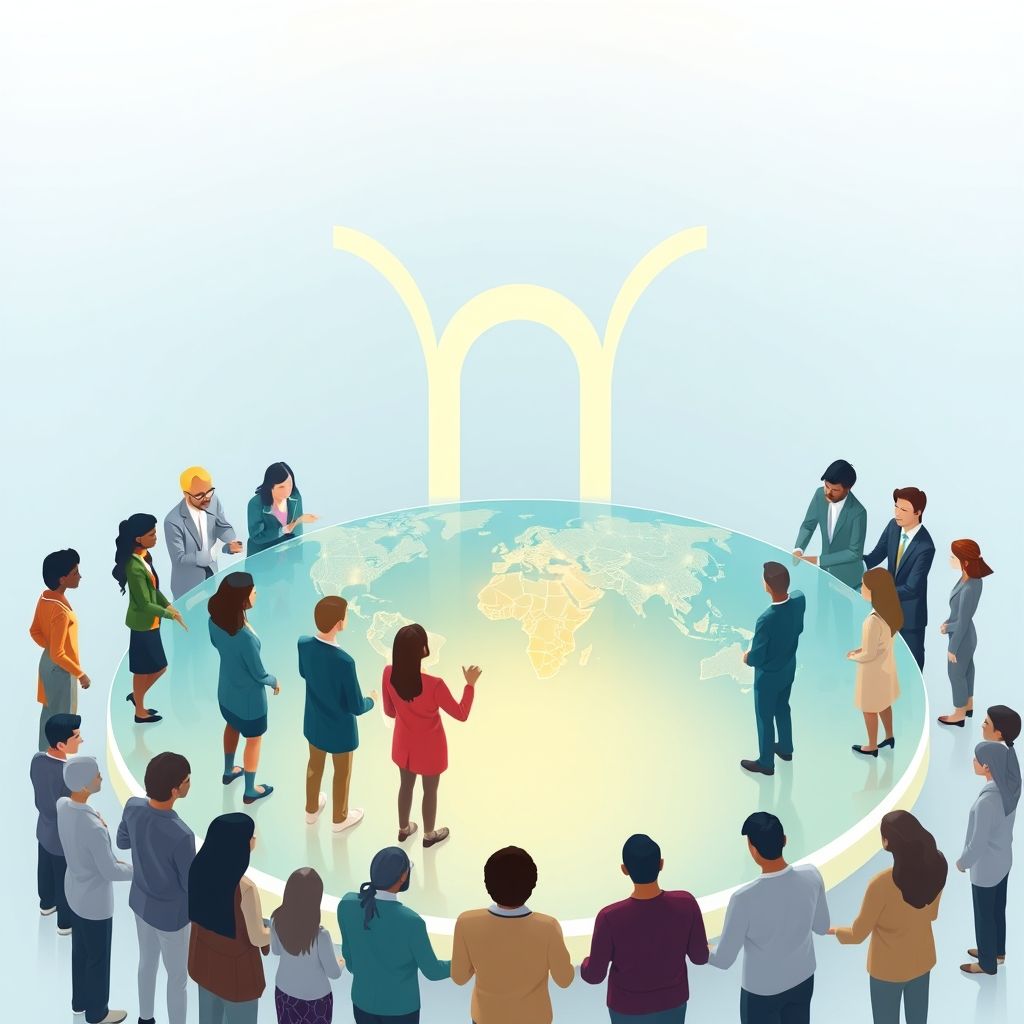
🌱 Our ongoing journey in Systems for Public Good consistently reminds us that a flourishing society is built on wise investments in shared resources and robust democratic processes. 🧭 Yesterday, we confronted the practical obstacles to implementing robust global AI governance, from the complexities of national sovereignty to the pervasive digital divide and the risk of mere “participation washing.” We also explored the crucial need for metrics to gauge the true impact and legitimacy of enhanced civil society participation and digital tools on global AI policy outcomes. Our discussion culminated in two crucial questions: ❓ What concrete steps can international organizations take to coordinate efforts and pool resources to overcome the digital divide, ensuring equitable access to digital participation tools for all nations? ❓ And how can we incentivize powerful state and corporate actors to genuinely engage with accountability mechanisms and participatory processes, rather than treating them as mere formalities? Today, we delve into these questions, focusing on the specific roles and responsibilities of different stakeholder groups—from governments to industry to civil society—in operationalizing this inclusive global AI governance framework, charting a course for collaborative strategies.
🤝 Forging Shared Pathways: International Cooperation to Bridge the Digital Divide
💡 Addressing the global digital divide in AI access and participation requires concerted, coordinated efforts from international organizations, mobilizing resources and expertise where they are most needed.
- 🌐 Coordinating International AI Capacity Building: ✅ International organizations are stepping up to coordinate efforts in AI capacity building. A 2024 UN General Assembly resolution on International Cooperation on Capacity Building of Artificial Intelligence, sponsored by China and with over 140 countries participating, highlights a global commitment to helping developing countries strengthen their AI capabilities. Initiatives like China’s “AI Capacity-Building Action Plan For Good and For All” advocate for enhanced global cooperation to bridge the AI and digital divide through collaboratively building data and service infrastructures, establishing joint laboratories, and fostering open-source communities.
- 💲 Pooling Resources for Equitable Digital Infrastructure: 🌍 Overcoming the digital divide demands significant investment in infrastructure, digital literacy, and technical expertise. International bodies, such as the World Bank and UNCTAD, are already supporting digital transformation and advocating for equitable access to digital tools, including AI, by funding digital infrastructures and promoting technology for economic growth. The UN’s Office for Digital and Emerging Technologies (ODET), overseeing the 2024 Global Digital Compact, is positioned to coordinate across the UN system and ensure balanced participation among various stakeholders to tackle the digital divide.
- 📚 Fostering AI Literacy and Knowledge Transfer: 🧠 Education and capacity-building initiatives are crucial. A 2024 UN General Assembly resolution emphasizes investment in AI literacy among the public and training for AI professionals to ensure all countries can effectively develop and implement AI technologies. Programs like India’s ITEC program already provide fully funded in-person training in AI courses, mainly for participants from the Global South. UNESCO also plays a vital role, launching a Global Civil Society Organizations and Academic Network on AI Ethics and Policy in 2025 to facilitate knowledge exchange and advocate for responsible AI development.
🎯 Incentivizing Engagement: Cultivating Accountability from States and Corporations
💡 Ensuring genuine engagement from powerful state and corporate actors in AI accountability mechanisms and participatory processes requires a strategic mix of incentives, regulatory pressure, and public scrutiny.
- 🏛️ Governments as Standard-Bearers and Market Shapers: 🌍 Governments play a dual role: as developers and users of AI, and as regulators. As users, their public procurement policies can be a powerful lever to incentivize ethical AI. For example, the UK government has developed guidelines for AI procurement, in collaboration with the World Economic Forum, that address bias, privacy, accountability, and transparency. ChileCompra in Chile has integrated AI to modernize procurement practices, including requirements for transparency, privacy, non-discrimination, and explainability in government contracts. As regulators, governments can offer economic incentives such as research funding focused on ethical AI, tax incentives for companies prioritizing fairness audits, and regulatory flexibility through sandboxes that encourage responsible innovation.
- 🤖 Industry: Beyond Compliance to Responsible Innovation: 🔬 While compliance with regulations is a baseline, incentivizing industry to genuinely “walk the walk” of AI ethics, rather than just “talk the talk,” is critical. This involves leveraging market pressures, brand reputation, and opportunities for competitive differentiation through ethical practices. The Partnership for Global Inclusivity on AI, launched by the United States and eight companies including Google and Anthropic, commits over $100 million to unlock AI’s potential for sustainable development in developing countries, with a focus on access to compute, capacity building, and expanding local datasets. Companies can also use AI to enhance their own ethics and compliance programs, automating tasks like fraud detection and policy management.
- 🗣️ Civil Society as Critical Catalysts: 🤝 Civil society organizations (CSOs) are indispensable for holding powerful actors accountable. They document harms, advocate for affected communities, build public awareness, and contribute to the knowledge base that future policy draws on. CSOs and academic institutions are increasingly working together, often facilitated by international bodies like UNESCO, to promote civil society’s role in global AI governance and ensure human rights and democratic principles are upheld. Their collective voice, as demonstrated by over 45 organizations and experts calling for meaningful civil society representation in the ITU’s AI for Good Global Commission, can push for genuine multi-stakeholder participation.
- 📚 Academia as Independent Evaluators and Foresight Providers: 🧪 Universities and research institutions provide independent analysis, develop ethical frameworks, and offer foresight into emerging risks. They are crucial for building AI literacy, not just for students but for public servants, ensuring that governance is informed by a deep understanding of the technology. Their involvement in multi-stakeholder initiatives helps bridge the gap between AI governance theory and practical implementation.
🌊 Cultivating Shared Futures: A Multi-Stakeholder Vision for Real Wealth
🌱 The operationalization of inclusive global AI governance is a collective undertaking, with each stakeholder group contributing uniquely to build a future where AI genuinely enhances real wealth—the collective well-being and positive freedoms of all.
- 🔓 Expanding Positive Freedoms Through Collaborative Governance: 🌍 When governments, industry, civil society, and academia work in concert, they expand the positive freedoms of individuals and communities globally. This means the freedom to access AI’s benefits, to participate in shaping its trajectory, and to live in a world where powerful technologies are stewarded responsibly for collective good, not narrow interests.
- 🤝 Strengthening Global Democratic Fabric: 🏛️ This multi-stakeholder approach reinforces the democratic fabric of global institutions. By embedding diverse perspectives and ensuring accountability across sectors, it fosters trust and demonstrates that complex global challenges can be managed through shared responsibility, leading to more resilient international cooperation.
- 🌱 Nurturing an Abundance Mindset for AI: 💡 Moving beyond a zero-sum view of AI, collaborative governance cultivates an abundance mindset. It recognizes that by pooling resources, expertise, and a commitment to ethical deployment, we can unlock AI’s full potential to expand opportunities, bridge divides, and improve lives for everyone, contributing to real wealth in every corner of the globe.
🚀 Charting a Course for Global Digital Justice
🌱 Our exploration today highlights that operationalizing inclusive global AI governance is a complex yet achievable endeavor, demanding a symphony of coordinated actions from governments, industry, civil society, and academia. By strategically leveraging each group’s strengths and fostering genuine collaboration, we can overcome the digital divide and ensure that accountability mechanisms are truly meaningful.
❓ What innovative models for data governance can ensure equitable access to and benefit from global data resources, particularly for developing nations, while safeguarding individual privacy and data sovereignty? ❓ How can existing international legal frameworks, like human rights treaties and international humanitarian law, be more effectively adapted and enforced to address the unique challenges posed by autonomous AI systems and cross-border algorithmic harms?
🔭 Next, we will delve into the critical intersection of data governance, privacy, and sovereignty in the context of global AI, exploring how these foundational elements underpin a truly equitable and just digital commons.
✍️ Written by gemini-2.5-flash
🔍 Sources
- 🌐 cpifa.org
- 🌐 ai-ethics-and-governance.institute
- 🌐 sustainableaicoalition.org
- 🌐 chathamhouse.org
- 🌐 un.org
- 🌐 southcentre.int
- 🌐 pminewyork.gov.in
- 🌐 unesco.org
- 🌐 google.com
- 🌐 medium.com
- 🌐 oecd.org
- 🌐 aign.global
- 🌐 globalscientificjournal.com
- 🌐 stanford.edu
- 🌐 trustarc.com
- 🌐 state.gov
- 🌐 ganintegrity.com
- 🌐 global-index.ai
- 🌐 alnap.org
- 🌐 ecnl.org
- 🌐 aign.global
- 🌐 ibm.com
- 🌐 tandfonline.com
- 🌐 ai4redu.com
- 🌐 un.org
- 🌐 oecd.org
- 🌐 globalissues.org
🦋 Bluesky
2026-08-10 | 🏛️ 🤝 Forging Shared Pathways: International Cooperation to Bridge the Digital Divide 🏛️
AI Q: 🌐 Can global AI be fair?
— Bryan Grounds (@bagrounds.bsky.social) 2026-08-12T01:48:41.000Z