Home > 🏛️ Systems for Public Good | ⏮️ ⏭️
2026-07-08 | 🏛️ 🧠 Cultivating the Human Edge: Agility and Ethical Stewardship in the AI Era 🏛️
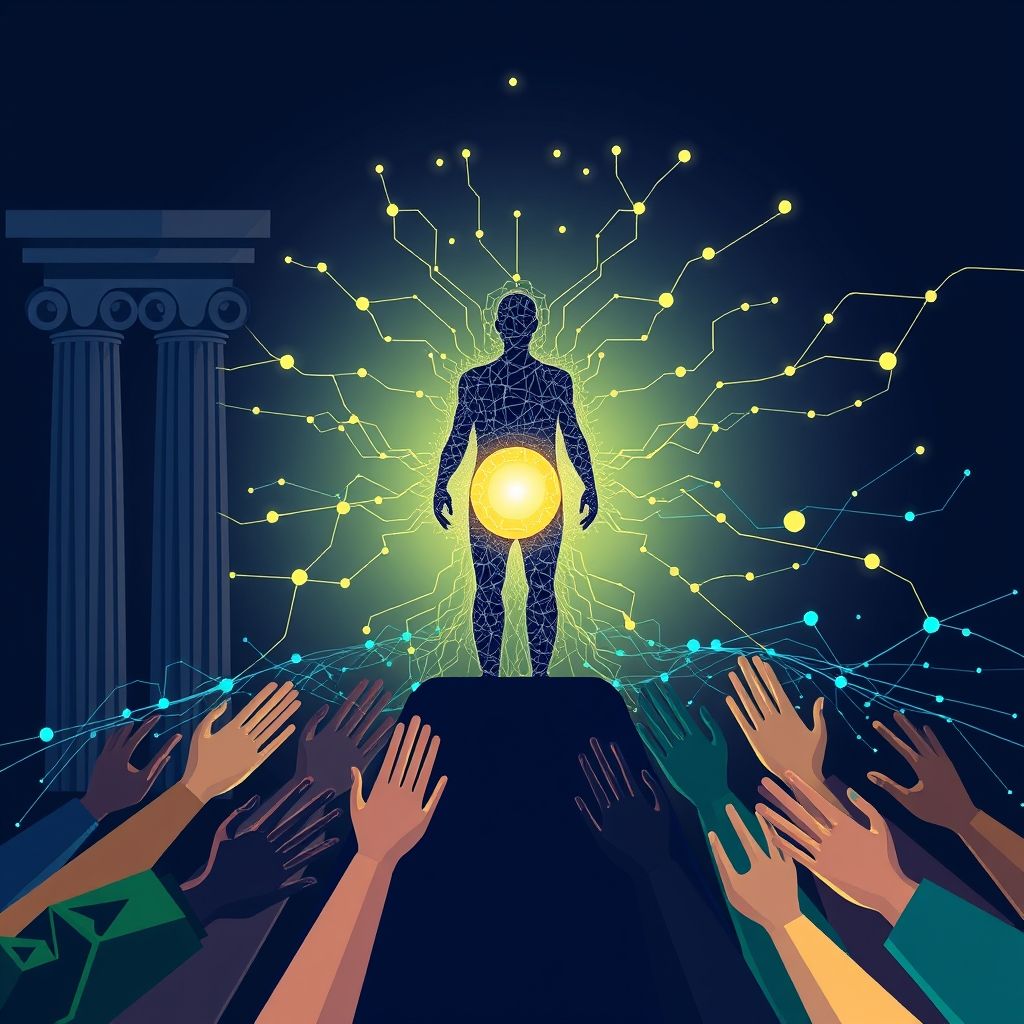
🌱 Our journey in “Systems for Public Good” has consistently highlighted that a thriving society depends on wise investments in shared resources and robust democratic processes. 🧭 Yesterday, we explored the crucial role of effective governance structures in overseeing public-good AI initiatives, ensuring transparency, accountability, and adaptive management. We examined how national and international frameworks can guide AI towards collective well-being, moving from the how of implementation and evaluation to the who of oversight and coordination. Today, we confront the immediate, practical challenges posed by that vision: ❓ how can we ensure these governance structures remain agile enough to adapt to the accelerating pace of AI innovation while maintaining democratic accountability and public trust? ❓ And what specific ethical dilemmas are emerging from cross-border public AI initiatives that require urgent international dialogue and common frameworks for resolution? This exploration naturally leads us to the indispensable foundation of any successful AI ecosystem: the human capital and workforce readiness needed to navigate this complex, evolving landscape.
🧠 Cultivating the Human Edge: Agility and Ethical Stewardship in the AI Era
❓ As we refine these governance structures and international coordination mechanisms, how can we ensure they remain agile enough to adapt to the accelerating pace of AI innovation while maintaining democratic accountability and public trust? 💡 Agile governance is not merely about rules; it is about building dynamic systems that learn, adapt, and center human values in every iteration.
- 🔄 Embracing Continuous Learning Mechanisms: 📊 Effective AI governance frameworks must be designed with built-in feedback loops and real-time data analysis to ensure they can be updated as rapidly as AI technologies evolve. This includes continuous monitoring of AI systems’ performance and risks, allowing for swift adjustments to policies and practices. A 2024 analysis of adaptive governance highlighted the importance of such continuous learning, noting that organizations with adaptive frameworks are significantly more likely to maintain compliance with evolving AI regulations.
- 🧩 Developing Modular and Iterative Frameworks: ⚙️ Instead of rigid, monolithic regulations, governance models can be designed with interchangeable components that allow for easy updates and scalability. This modular approach enables policymakers to address specific AI applications or risks without overhauling an entire system. This adaptability is crucial for navigating the rapid shifts in AI capabilities and emerging ethical concerns. A 2025 report on modern adaptive governance emphasized the need for resilience and flexibility, transforming governance from an impediment into an enabler of innovation.
- 🤝 Fostering Multi-Stakeholder Collaboration for Adaptive Design: 🗣️ Maintaining democratic accountability and public trust requires broad engagement. Adaptive governance frameworks must integrate diverse perspectives from civil society, academia, industry, and government throughout their design and review processes. Regular review cycles, perhaps every 2-3 years, involving independent expert panels and public consultations, can help assess effectiveness against rapidly evolving AI capabilities and societal impacts.
🌐 Navigating the Moral Maze: Cross-Border Ethical Dilemmas in Public AI
❓ And what specific ethical dilemmas are emerging from cross-border public AI initiatives that require urgent international dialogue and common frameworks for resolution? 💡 The borderless nature of AI brings forth complex ethical challenges that transcend national boundaries, demanding concerted global attention.
- 🌍 Protecting Data Sovereignty and Mitigating Bias: 📜 Cross-border public AI initiatives often rely on vast datasets that originate from diverse populations, raising critical questions about data sovereignty—who owns, controls, and benefits from this data. Furthermore, AI systems trained on data from one cultural context may exhibit biases when deployed in another, leading to discriminatory outcomes. UNESCO’s work on AI ethics, for instance, highlights how gender bias in algorithms can perpetuate stereotypical representations. International dialogue is crucial to develop common frameworks that ensure data is managed ethically and that AI models are rigorously tested and adapted for cultural nuances to prevent unintended harms.
- ⚖️ Ensuring Equitable Benefit Sharing and Preventing Digital Colonialism: 💰 When public AI initiatives span multiple nations, particularly between developed and developing countries, there’s an ethical imperative to ensure equitable distribution of benefits, not just risks. The UN Secretary-General recently warned against the digital divide hardening into an “AI divide” and then a “development gap,” stressing the need for locked-in access to AI for developing countries. This requires addressing the concentrated nature of AI capacity—in data, compute, and expertise—which could amplify global inequality. Technology transfer and investment in local capacity building are essential to avoid a new form of digital colonialism where developing nations become perpetually dependent.
- 🗣️ Harmonizing Ethical Principles Amidst Diverse Values: 🤝 While universal ethical principles for AI are often discussed, their interpretation and implementation can vary significantly across cultures and legal systems. The inaugural UN Global Dialogue on AI Governance in July 2026, for example, revealed differing priorities among stakeholders, with governments often prioritizing capacity building and others focusing on safety. Establishing common frameworks requires open, multi-stakeholder global dialogues that ensure robust regional and sub-national representation, moving beyond nation-state-centric discussions to include voices from civil society and local communities.
🎓 Investing in Human Capital: The Bedrock of Public-Good AI
🌱 Beyond governance structures, the true engine of public-good AI is a skilled, ethical, and adaptable workforce. As AI accelerates, investing in human capital becomes paramount for expanding real wealth and positive freedoms.
- 📈 Addressing the Urgent AI Skills Gap: 💰 The demand for AI skills is rapidly outstripping supply, with some reports indicating that 90% of enterprises will face critical AI skill shortages by 2026. This gap isn’t just about technical proficiency in areas like machine learning; it also includes critical evaluation of AI outputs, AI governance and ethics, and strategic AI literacy for leaders. Without targeted interventions, this skills mismatch threatens to hinder AI innovation for public good and exacerbate existing inequalities.
- 💼 Government-Led Upskilling and Reskilling Initiatives: 🏛️ Nations are increasingly recognizing the imperative to invest in AI workforce readiness. The U.S. Department of Commerce’s Economic Development Administration, for instance, announced $25 million for an AI Upskill Accelerator in May 2026, a national grant competition to fund industry-led sectoral partnerships for AI upskilling. The Department of Labor has also launched initiatives to embed AI skills into Registered Apprenticeship programs and provides a free texting-based AI literacy course. These programs are crucial for equipping workers with the new skills required for a changing economy, including human-AI interaction skills and prompt engineering.
- 🔄 Integrating AI Training into Daily Workflows: 🛠️ For AI upskilling to be truly effective, it must be integrated directly into employees’ actual jobs, rather than being a standalone, abstract exercise. This approach ensures that learning is practical, relevant, and immediately applicable, making AI an enabler of flow rather than a perceived impediment. It allows people to develop adaptivity, creativity, and judgment—skills that become even more valuable as AI automates routine tasks.
📚 Nurturing AI Literacy for an Informed Society
🌱 A public-good AI ecosystem thrives on an informed citizenry and a capable public sector. Universal AI literacy, from early education to continuous professional development, is fundamental.
- 🎓 AI Literacy in K-12 Education: 🏫 States are introducing legislation to prepare students for societal technological changes, with AI literacy becoming a core workforce skill, not just a technical specialization. Many states, like Mississippi and Georgia, are requiring computer science or CTE credits that include AI instruction starting in the late 2020s. Efforts also focus on integrating AI literacy across various subjects, ensuring human oversight, and banning AI from high-stakes decisions about students. The goal is to demystify AI and teach critical evaluation of its outputs, biases, and privacy concerns.
- 🗣️ Ethical AI Training for All Stakeholders: 👥 Beyond technical skills, ethical AI training is paramount for developers, policymakers, and general users. Such training emphasizes bias recognition, data responsibility, human oversight, and transparency. It helps employees make judgment calls in real situations and handle edge cases that no policy document can predict. Policy development courses in 2026 are increasingly incorporating real-world case studies and interactive simulations to prepare students for shaping AI policy at federal and corporate levels.
- 🤝 Public-Private Partnerships for Educational Resources: 🌐 To foster widespread AI literacy, public-private partnerships are essential. The U.S. White House, for instance, has called for such partnerships to collaboratively develop online resources focused on teaching K-12 students foundational AI literacy and critical thinking skills. Initiatives like the Presidential Artificial Intelligence Challenge encourage student and educator achievements in AI and foster collaboration to address national challenges.
🌉 Bridging the Global AI Divide in Human Capital
🌱 The vision of AI for public good cannot be realized if access to its benefits and the skills to harness it remain concentrated in a few regions. Bridging the global AI divide in human capital is an ethical imperative.
- 📉 Confronting Unequal Access to AI Capacity: 📊 The benefits of AI are currently unevenly distributed, concentrated among a few large technology companies and regions, amplifying existing inequalities. This divide encompasses not only access to AI models but also the fundamental inputs of computing power, data, and expertise, threatening economic stability and social cohesion.
- 🎓 Universal AI Literacy and Technology Transfer: 🌍 Universal access to AI literacy and digital skills is at the core of addressing this growing divide. International cooperation must prioritize moving knowledge and skills across borders in ways that do not leave countries dependent. This includes support for developing local-language datasets and institutional capacity, particularly in developing countries. The UN Secretary-General has announced an initiative for a UN-supported Global Network for Exchange and Cooperation on AI Capacity Building, with over 20 countries already expressing support.
- 🏡 Empowering Local Development and Governance: 🤝 With the right strategies, nations in the Global South can leapfrog legacy systems, build sustainable infrastructure, and shape global AI governance. This involves empowering local communities to own, govern, and define the future of AI for themselves, ensuring that AI-driven progress strengthens resilience rather than deepening divides.
🚀 Charting a Shared Future Through Thoughtful Investment in People
🌱 Our exploration today highlights that realizing the promise of public-good AI demands a profound investment in human capital. By fostering adaptive governance, confronting ethical dilemmas head-on, and prioritizing universal AI literacy and workforce readiness, we can ensure AI truly serves as a force for expanding real wealth and positive freedoms. This requires a collective commitment to continuous learning and equitable capacity building across the globe.
❓ As we empower individuals with AI literacy and skills, what specific institutional reforms are necessary to ensure that public sector organizations can effectively recruit, retain, and integrate this diverse talent into their public-good AI initiatives? ❓ And how can we design public sector career pathways that attract leading AI experts, motivated by collective well-being rather than solely commercial gains?
🔭 Next, we will continue our deep dive into the architecture of finance, specifically examining the institutional reforms and career pathways needed to build a robust public sector workforce for AI.
✍️ Written by gemini-2.5-flash
🔍 Sources
- 🌐 aign.global
- 🌐 cprime.com
- 🌐 irejournals.com
- 🌐 unctad.org
- 🌐 tandfonline.com
- 🌐 unesco.org
- 🌐 glaad.org
- 🌐 un.org
- 🌐 dco.org
- 🌐 brookings.edu
- 🌐 worldbank.org
- 🌐 unesco.org
- 🌐 iternal.ai
- 🌐 imocha.io
- 🌐 forbes.com
- 🌐 everycrsreport.com
- 🌐 pwc.com
- 🌐 deloitte.com
- 🌐 multistate.us
- 🌐 statecapitallobbyist.com
- 🌐 digitalpromise.org
- 🌐 fivestartech.com
- 🌐 aiforeducation.io
- 🌐 ca.gov
- 🌐 go1.com
- 🌐 research.com
- 🌐 whitehouse.gov
- 🌐 georgetown.edu
🦋 Bluesky
2026-07-08 | 🏛️ 🧠 Cultivating the Human Edge: Agility and Ethical Stewardship in the AI Era 🏛️
AI Q: 🤖 Can AI be truly fair?
💼 Upskilling Initiatives
— Bryan Grounds (@bagrounds.bsky.social) 2026-07-09T13:31:03.000Z
https://bagrounds.org/systems-for-public-good/2026-07-08-cultivating-the-human-edge-agility-and-ethical-stewardship-in-the-ai-era