📈🏭💰 Sim Companies
🤖 AI Summary
👉 What Is It?
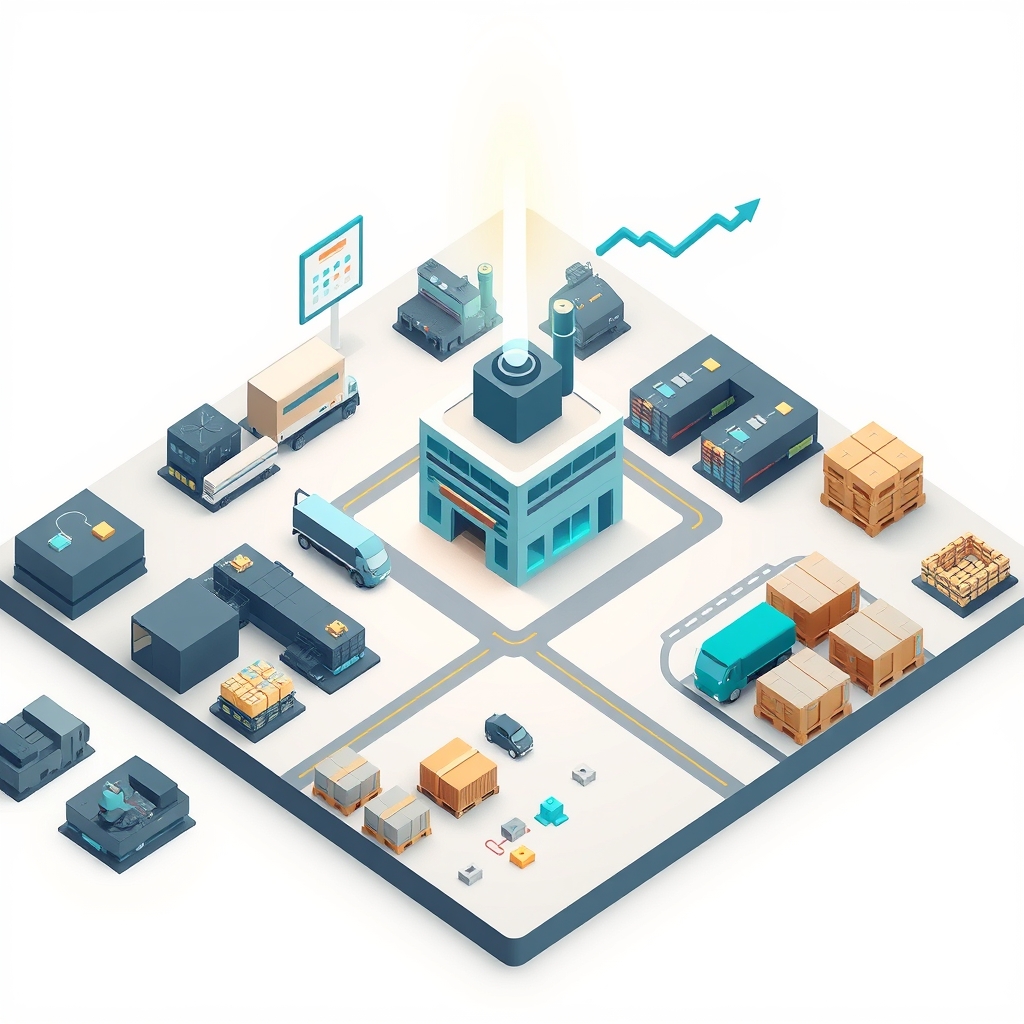
- 🏢 Sim Companies is a browser-based, massively multiplayer online (MMO) business simulation game.
- 📈 It belongs to the tycoon or management simulation genre, specifically focusing on micro- and macro-economic principles.
- 🌐 It simulates a player-driven global economy where users manage supply chains, production, retail, and research.
☁️ A High Level, Conceptual Overview
- 🍼 For A Child: Imagine a digital lemonade stand where you have to buy lemons, find someone to make juice, and then find people who want to buy your juice.
- 🏁 For A Beginner: You manage a virtual business by balancing production costs against market prices, deciding when to build new facilities, and trading resources with other real-life players.
- 🧙♂️ For A World Expert: It is a dynamic, agent-based economic simulation where aggregate player behavior dictates price elasticity and market equilibrium, requiring rigorous optimization of resource flow through integrated value chains.
🌟 High-Level Qualities
- 🔄 Dynamic: The market is entirely player-driven; supply and demand fluctuations are based on real-time collective decisions.
- ⚖️ Balanced: The economy is designed to be fair, preventing singular monopolies from ruining the experience for newcomers.
- 📱 Accessible: Optimized for mobile-first play, allowing users to make business decisions in short bursts.
- 🛡️ Non-Predatory: Widely recognized by its community as a non-pay-to-win environment where strategy outperforms cash.
🚀 Notable Capabilities
- 🏭 Supply Chain Management: Designing and scaling complex production pipelines.
- 📊 Financial Analysis: Monitoring income statements, balance sheets, and market trends.
- 🤝 Peer-to-Peer Trading: Negotiating private contracts with other players to optimize costs.
- 🚀 Research & Development: Investing in patents to unlock higher efficiency and new product tiers.
📊 Typical Performance Characteristics
- ⏲️ Response Time: Changes in market supply/demand typically manifest in hourly or daily cycles.
- 👥 Scale: Supports thousands of concurrent users in a shared, persistent global market.
- 🖥️ Resource Footprint: Extremely lightweight, as it functions as a progressive web app (PWA) with minimal data overhead.
💡 Examples Of Use
- 🏢 Retail Tycoon: A player builds high-level shopping malls and focuses entirely on selling high-margin consumer electronics.
- 🔬 Researcher: A company specializes solely in the production of high-value research points to sell to large manufacturing corporations.
- 🚛 Logistic Specialist: A player acts as a middleman, buying raw materials in bulk and distributing them to smaller producers at a markup.
📚 Relevant Theoretical Concepts
- 📉 Supply and Demand: The core engine of the game’s market.
- ⚙️ Value-Added Tax/Margins: Calculating gross vs. net profit.
- ⛓️ Vertical Integration: Bringing different stages of production under one company.
- 🧠 Opportunity Cost: Choosing whether to produce a good or buy it from the market.
🌲 Topics
- 👶 Parent: Business Simulation Games, MMOs.
- 👩👧👦 Children: Supply Chain Logistics, Market Trading, Retail Management, Executive Leadership.
- 🧙♂️ Advanced: Elasticity of Demand, Market Equilibrium Modeling, Automated Trading Scripts.
🔬 A Technical Deep Dive
- 🧪 The game uses a proprietary engine that simulates retail demand based on the total volume of goods available in the market.
- 🔢 When players sell items, the system aggregates the supply across all companies to determine the sales rate, preventing any one user from instantly crashing the market.
- 📡 It relies on a persistent database where every transaction (contract or market listing) affects the global state.
🧩 The Problem(s) It Solves
- 📦 Abstract: Simplifies the complexity of real-world global economics into a playable, fun loop.
- 📈 Common: Teaching players the value of time-to-market and the importance of resource management.
- 😲 Surprising: It helps users understand why just-in-time manufacturing is risky when supply chains are disrupted.
👍 How To Recognize When It’s Well Suited
- 🧠 You want to learn business logic without the risks of real-world bankruptcy.
- ⏳ You have limited time but enjoy long-term strategic progression.
- 📉 You are interested in data-driven decision-making and market analytics.
👎 How To Recognize When It’s Not Well Suited
- 💥 You want fast-paced, action-oriented gameplay (e.g., combat or shooters).
- 🏢 You prefer games with heavy narrative-driven cutscenes or roleplay.
- 🚫 You find accounting or spreadsheet-style management tedious rather than satisfying.
🩺 How To Recognize When It’s Not Being Used Optimally
- 📉 Your production costs consistently exceed market sale prices.
- 🧱 You are bottlenecked by raw materials because you aren’t using trade contracts.
- 💤 Your factory capacity is sitting idle due to poor resource planning.
🔄 Comparisons
- 🆚 vs. Factorio: Factorio is about mechanical automation and physical space; Sim Companies is about financial automation and market timing.
- 🆚 vs. Eve Online: Eve is a complex, high-stakes sandbox with combat; Sim Companies is a dedicated, streamlined business simulation.
📜 History
- 📅 Launched in September 2019 by Sim Companies S.R.O.
- 🏗️ Designed to remove the tedious aspects of real-world management (like taxes or regulations) to focus on the core thrill of entrepreneurship.
📝 Dictionary-Like Example
- 🗣️ After optimizing my supply chain, my company’s valuation increased significantly in the Sim Companies market.
❓ FAQ
- ❓ Is it pay-to-win? No, the community consistently rates it as a skill-based experience.
- ❓ Do I need to be online 24/7? No, the game is designed for asynchronous play.
- ❓ Can I play on my phone? Yes, it is fully optimized for mobile browsers.
📖 Book Recommendations
- 📚 Topical: The Goal by Eliyahu M. Goldratt.
- 📚 Tangentially Related: 🤔🐇🐢 Thinking, Fast and Slow by Daniel Kahneman.
- 📚 Accessible: The Personal MBA by Josh Kaufman.
- 📚 Fictional: Atlas Shrugged by Ayn Rand (for the themes of industrial struggle).
- 📚 Rigorous: Microeconomic Theory by Mas-Colell, Whinston, and Green.
🦋 Bluesky
📈🏭💰 Sim Companies
AI Q: 📈 Prefer managing a virtual empire or the real world?
💹 Economic Simulation | 🚚 Supply Chain | 📊 Market Trading | 🏗️ Tycoon Management
— Bryan Grounds (@bagrounds.bsky.social) 2026-06-12T19:50:33.000Z
https://bagrounds.org/software/sim-companies