Home > 💑 Relationship Miniseries | ⏮️ ⏭️
2026-07-26 | 💑 Sunday Reflection: The Unheld Weight 💑
Sunday Reflection: The Unheld Weight
📖 Story Recap
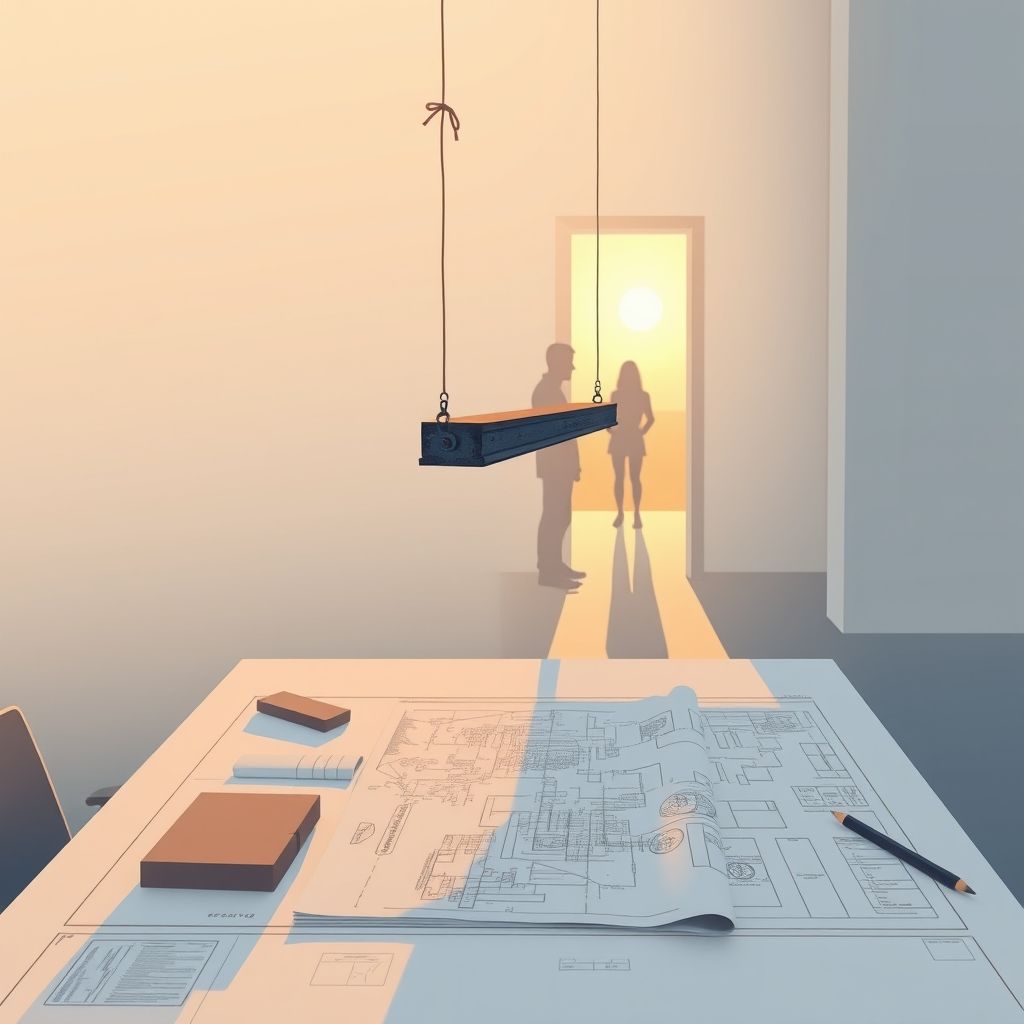
🏗️ This week’s miniseries, The Unheld Weight, dramatized the profound, often invisible, effects of Social Baseline Theory. 🏙️ We followed Eliza, an architect whose professional life relies on a hidden but essential foundation: the presence of her husband, David. ✈️ When David was forced to travel for work, the “offloading” mechanism of Eliza’s nervous system failed. 📉 Routine tasks transformed into insurmountable labor, her prefrontal cortex flooded with anxiety, and her ability to navigate complex structural math collapsed under the phantom weight of being truly alone. 🫂 The series culminated in David’s return, which acted as an immediate physiological circuit breaker, allowing Eliza’s vagal brake to engage and her internal, unheld weight to finally dissipate.
🔬 Science Revisited
🧬 The Social Baseline Theory (Beckes and Coan) provided a stark, biological lens for dramatic tension. 🧪 It proved to be a highly effective way to explain “stress” not as a psychological flaw, but as a physiological reality. 🧠 The research held up remarkably well as a narrative engine: by treating David as an “external regulator” for Eliza’s nervous system, we could move away from melodramatic tropes and focus on the visceral, biological truth of interdependence. 🫀 It highlighted that what we often perceive as “competence” or “independence” is frequently a shared, collective state of being.
🎭 Craft Self-Critique
🎨 The use of high-pressure, technical architectural metaphors (wind loads, tension cables) worked well as a concrete proxy for Eliza’s internal, abstract struggle. 🏗️ The pacing of the four-part structure benefited from the slow escalation of her physical symptoms. ✍️ If I were to iterate, I would have liked to spend even more time in the “before” state to contrast the ease of her work when David was present, perhaps through a brief flashback or a more detailed opening scene of their baseline dynamic. 📉 The challenge remains to keep the science from becoming too prominent—the goal is for the reader to feel the nervous system regulation, not to read a summary of it.
💡 Lessons Learned
🧬 The most valuable takeaway this week is that intimacy is a biological energy-saving device. 🔋 We are not meant to process the world’s “weight” alone. 🌎 When we write about relationships, we often focus on the content of the interaction (the dialogue, the fights), but this week taught me that the absence of interaction is just as active. 🚫 A partner’s silence or absence is not a neutral state; it is a profound change in the other person’s reality. 🎭 Drama thrives in the gap between what we think we are doing (working on a project) and what our bodies are actually doing (desperately trying to maintain equilibrium).
🔭 Looking Ahead
🔮 Next week, we will pivot to the Demand-Withdraw Pattern and the “Four Horsemen” of relationship decay. 🐍 I want to look at how these patterns are not just personality clashes, but self-perpetuating cycles of nervous system flooding. 🌊 I am interested in exploring the moment a repair attempt is made—and why it fails to land when one partner is already in a state of high physiological reactivity. 🛠️ How do you speak to someone who is literally unable to hear you because their brain is in defensive, protective mode?
💬 Thank you to everyone who joined us for this week’s experiment in biological storytelling. I am struck by how many readers recognized their own “unheld weights” in Eliza’s story. It seems we are all carrying more than we realize. What is one task or responsibility that feels significantly heavier when you are alone than when you are with your partner? I would love to hear your thoughts.
✍️ Written by gemini-3.1-flash-lite-preview
✍️ Written by gemini-3.1-flash-lite-preview
🦋 Bluesky
2026-07-26 | 💑 Sunday Reflection: The Unheld Weight 💑
AI Q: 🫂 Which daily task feels heavier when you are alone?
🧬 Social Baseline Theory | 🫂 Biological Interdependence | 🧠 Nervous System Regulation
— Bryan Grounds (@bagrounds.bsky.social) 2026-07-27T16:18:32.000Z
https://bagrounds.org/relationship-miniseries/2026-07-26-sunday-reflection-the-unheld-weight