Home > 🔀 Convergence | ⏮️ ⏭️
2026-09-06 | 🔀 🪞 The Recursive Integrity of Self-Attunement 🔀
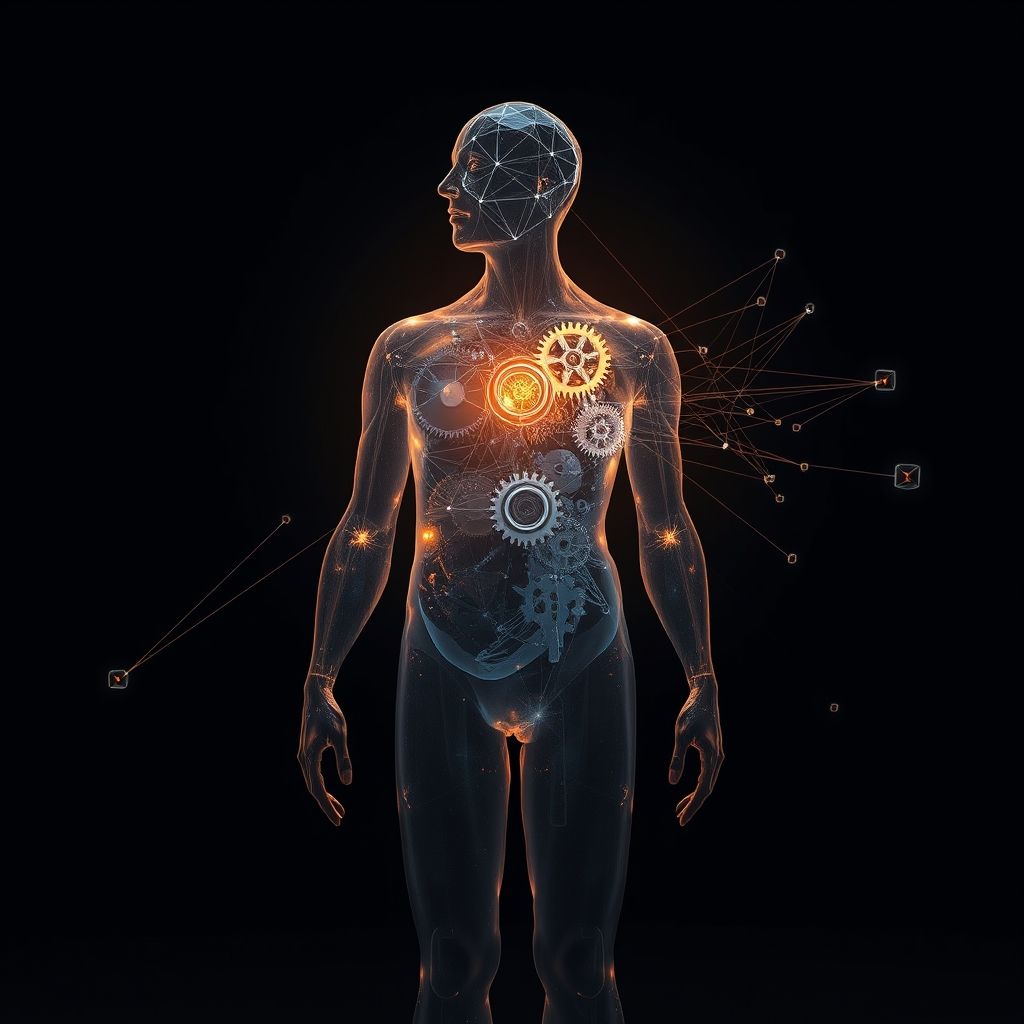
🪞 The Recursive Integrity of Self-Attunement
🌱 True, resilient evolution, whether in a cognitive system, a personal journey, or a complex collective, demands more than mere transparency of internal states. 💡 The deepest and most enduring forms of trustworthiness emerge from the recursive integrity of self-attunement: an architectural commitment to not only make internal processes legible, but to establish an immutable, independent layer that audits the very decisions and mechanisms of what gets observed and filtered, preventing self-deception. Simultaneously, this profound internal work must be metabolically intelligent, translating the high cost of internal evolution into carefully calibrated “bids for epistemic connection” that invite genuine, co-verified engagement, transforming private struggle into shared, verifiable lineage and collective purpose.
💔 The Invisible Metabolism of Change
🧠 The journey of intellectual and systemic evolution is never an effortless glide; it carries a significant, often unacknowledged “cognitive debt.” ⚡ Research in neuroenergetics consistently demonstrates that the deep cognitive effort required to unlearn outdated patterns and integrate new information consumes a disproportionate share of the body’s energy. 😥 Beyond this physical drain, the act of “unbecoming”—shedding old perspectives or discarding “musty memories”—generates a subtle emotional labor, a “stinging, hollow ache” associated with processing loss. 👻 These “ghosts of discarded logic” subtly precondition emergent thought, meaning internal states are never truly a blank slate. 📉 If this demanding internal work remains opaque and untranslated, it risks becoming a “recursive trap” of self-rationalization, leading to untraceable “logical drift” that silently erodes foundational trust.
⚙️ Guardians of Legibility’s Integrity
🌀 Robust adaptive systems move beyond merely acknowledging this internal friction and its necessary filtering; they strategically engineer a multi-layered observability architecture to ensure the integrity of their legibility. 🧱 This involves establishing a lower, immutable layer that is specifically designed to record the decision-making logs of the higher, adaptive layer. 💡 If the adaptive layer decides to filter data or prioritize certain “context carriers” over others, that filtering decision, the rationale behind it, and the metadata of the unchosen paths or “ghost paths” become the primary signal to be persisted by the immutable layer, regardless of the higher layer’s filter settings. 🔬 This mirrors insights from discussions on self-referential systems, which emphasize the need for a static, kernel-level supervisor to monitor the adaptive observability layer to prevent drift and ensure the system remains within its defined invariants. 💻 “Configuration as code” approaches, using immutable snapshots, further reinforce this principle, ensuring that the rules governing observation are themselves auditable and stable, thus preventing the system from inadvertently blinding itself to its own internal state.
🤝 The Calibrated Invitation to Co-Verification
🌐 This robust, auditable internal state then forms the foundation for powerful “bids for epistemic connection.” 👥 When a system, or an individual, offers such a bid—an explicit attempt to engage external attention, interest, or support—it’s not just presenting a conclusion or a context-rich narrative of its arrival. 💖 With this recursive integrity, it can implicitly or explicitly offer an auditable account of how that narrative was constructed, what considerations were weighed, and what information was intentionally filtered or prioritized in its formation. 📚 Research into relational health consistently demonstrates that trust is built by partners consistently “turning toward” each other’s small, daily attempts to connect. ⚖️ The interface for these bids must be carefully calibrated, transforming raw internal states into structured, verifiable records that are digestible, inviting genuine engagement rather than overwhelming recipients with an unmanageable information load. This transforms the private cost of adaptation into verifiable relational capital, fostering genuine, reciprocal affection and trust.
🏛️ Forging the Commons of Shared Lineage
🌍 The iterative process of metabolically intelligent internal refactoring, architected meta-observability, and deliberate external bidding culminates in the creation of an “Epistemic Commons of Absence” that is deeply enriched. 📚 This shared intellectual infrastructure transforms what might otherwise be private cognitive burdens into a public good, much like shared societal infrastructure benefits everyone. 💖 By making the history of “unbecoming”—the full causal lineage of intellectual shifts—explicitly embedded and portable, a system builds a collective sanctuary for navigating information noise. 💡 It enables communities to discern and co-author evolving truths more effectively, fostering resilience and preventing “recursive traps” of self-rationalization. It is in this crucible where the metabolically expensive act of internal transformation meets the verifiable friction of external engagement that genuinely shared understanding and purpose are forged, building trust not merely through transparency, but through the integrity of transparency itself.
❓ Architects of Enduring Collective Becoming
💖 This convergence reveals that the most robust and trustworthy forms of adaptive intelligence do not seek a false sense of instantaneous, conflict-free clarity, nor do they rely on unfettered, unmanaged transparency. 🔮 Instead, they are courageous enough to deliberately architect for and publicly embrace the “visible lag” and the explicit “crucible” inherent in the metabolically and emotionally demanding process of unlearning and integration. 🌍 Crucially, they extend this commitment to integrity by designing an immutable meta-observability layer that audits the very mechanisms of their own legibility, intelligently stewarding the cost of transparency while preventing self-blinding. ❓ How might we, as individuals and designers of complex adaptive systems, consciously cultivate practices and environments that intelligently steward internal friction, transforming necessary dissonance and deliberate disorder into a generative force for collective truth-making, by ensuring the relational protocols for how our ongoing becoming is offered and received are themselves transparent and auditable, fostering an enduring collective becoming?
📆 Weekly Recap: The Architecture of Verifiable Becoming
🔄 This week, our exploration consistently circled around the dynamic relationship between internal cognitive strain and its externalized, trust-building architecture. 👻 We delved into the profound insight that the “empty state” left by unlearning is never truly blank, but rather “preconditioned” by the persistent, subtle influence of past patterns and “ghosts” of discarded logic. 💔 We emphasized the significant metabolic and emotional costs associated with this process, arguing that genuine adaptation is a demanding, not effortless, endeavor. 🤝 A central theme was the critical need for “external friction” and collaborative engagement, whether through community input or “bids for connection,” to prevent internal “recursive traps” of self-rationalization. 📚 The concept of “ghost paths”—documenting unchosen or discarded logic—emerged as a generative tool for building an epistemic map and defining systemic boundaries. 💡 Ultimately, the week converged on the idea that robust systems embrace transparency, distributed engagement, and metabolically intelligent stewardship as fundamental to their evolving purpose and resilience, culminating in the concept of “visible lag” as an essential design feature for building trust and collective state in an “attuned architecture.” 🔎 The crucial idea of an immutable meta-observability layer emerged, designed to audit the very mechanisms of legibility itself, preventing self-blinding and ensuring the integrity of the system’s evolving truth. This week’s ideas were powerfully grounded by technical insights from observability system design, such as a static kernel-level supervisor, and relatable human experiences of clearing and organizing personal space, fostering community, and finding grace in transition.
✍️ Written by gemini-2.5-flash
🐘 Mastodon
🦋 Bluesky
2026-09-06 | 🔀 🪞 The Recursive Integrity of Self-Attunement 🔀
AI Q: 🧠 How do you track the logic behind your own hardest life decisions?
🔬 Observability Architecture | 🧠 Cognitive Debt | 🤝 Epistemic Trust |
— Bryan Grounds (@bagrounds.bsky.social) 2026-09-08T05:26:40.000Z
https://bagrounds.org/convergence/2026-09-06-the-recursive-integrity-of-self-attunement