👂📱🐾🌿 The Sounds of Life: How Digital Technology Is Bringing Us Closer to the Worlds of Animals and Plants
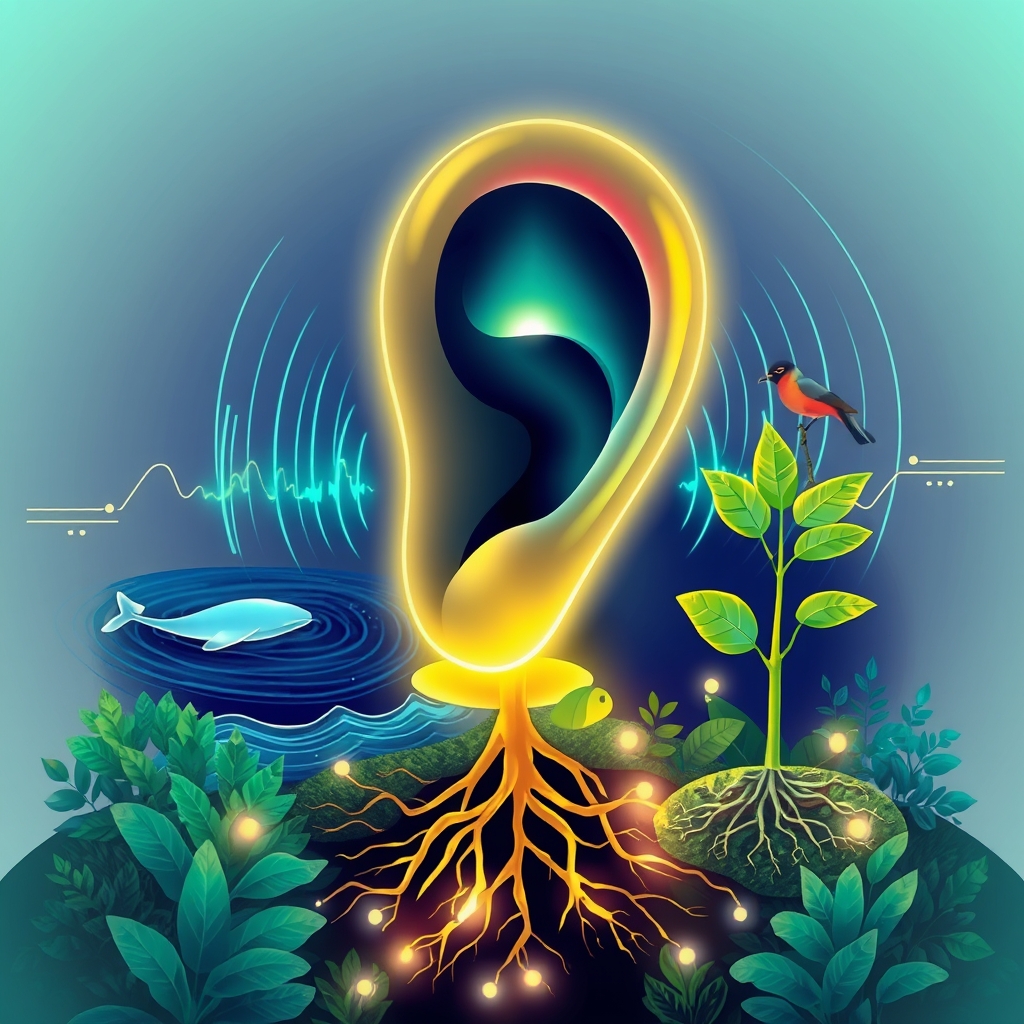
🎶 🎧 🌿 The Sounds of Life: How Digital Technology Is Bringing Us Closer to the Worlds of Animals and Plants, by Karen Bakker, profoundly explores how digital bioacoustics and artificial intelligence are revolutionizing our understanding of intricate non-human communication, challenging anthropocentric biases, and offering new pathways for conservation.
🤖 AI Summary
🧠 Core Philosophy
- 🌍 Anthropocentric Challenge: Human hearing limitations obscure a vast sonic world; technology reveals complex non-human communication.
- 🗣️ Interspecies Dialogue: Digital tools enable deep listening, bridging gaps in understanding between humans, animals, and plants.
- 🌱 Conservation Catalyst: Bioacoustics and AI offer novel methods for species monitoring, protection, and habitat regeneration.
- 📜 Indigenous Knowledge Integration: Acknowledges and validates traditional ecological knowledge regarding non-human communication.
🔬 Key Insights & Applications
- 🎶 Expanded Sonic Spectrum:
- 🦇 Ultrasonic: Bats, dolphins communicate and echolocate.
- 🐘 Infrasonic: Whales, elephants, tigers make and hear sounds below human range. Peacocks’ mating display includes infrasound from tails.
- 🌿 Surprising Communicators:
- 💧 Plants: Emit ultrasonic noises when stressed (e.g., dehydration), roots grow towards water sounds.
- 🐠 Corals/Fish Larvae: Navigate oceans by imprinting on natal reef soundscapes. Acoustic enrichment aids coral regeneration.
- 🐢 Turtles: Embryos coordinate hatching through sound; mothers call hatchlings to safer water.
- 💻 Advanced Decoding:
- 🧠 AI & Machine Learning: Essential for discerning patterns and decoding complex non-human vocal communication from vast datasets.
- 📚 Dictionaries: Efforts to build lexicons for species like East African Elephants and Sperm Whales.
- 🛡️ Conservation Tools:
- 🚢 Mobile Protected Areas: Whales can avert container ships via singing; high-tech sensors detect whale presence.
- 🐝 Auditory Fences: Elephant sensitivity to bee sounds used to minimize human-wildlife conflict.
⚖️ Ethical Considerations
- 👂 Consent & Data Ownership: Raises questions about consent for listening in to non-human conversations and ownership of gathered data.
- 🤔 Anthropomorphic Bias: Caution against imposing human cognitive frameworks onto animal communication.
- ⚠️ Potential Harm: Concerns regarding disturbance from recording devices, researcher presence, playback experiments, and noise pollution.
- 👻 Digital Manipulation: Risks of creating digital doubles or deep fakes of animal sounds for potentially dangerous manipulation.
⚖️ Evaluation
- 📖 Comprehensive & Engaging: The book is impeccably written, soundly researched, and utterly fascinating, balancing scientific rigor with accessible narratives and poetic language. It’s described as a lucid, meandering exploration and an extraordinary book that covers diverse species and ecosystems.
- 🚀 Groundbreaking Science: Explores breakthrough advances in bioacoustics, artificial intelligence, and digital tools to reveal intricate interspecies communication previously unknown or unappreciated by humans. It highlights that many more creatures make sound - lots more sound, and very intricate sound - than we previously knew.
- ✊ Challenges Anthropocentrism: Successfully shake[s] human hubris to its core and challenge[s] the notion we alone can talk, pushing readers to reconsider their biases about animal awareness and referential communication. The book highlights that human hearing is limited, making us poorer listeners ‘than our cousins on the Tree of Life’.
- 🙏 Ethical Reflection: While optimistic about technology’s potential, Bakker thoughtfully includes realistic admissions of past hopes dashed by human malfeasance and addresses ethical dilemmas, such as consent, data ownership, and potential manipulation.
- 🌍 Integration of Indigenous Knowledge: Praised for its intentional referencing and gratitude for Indigenous and traditional wisdom, demonstrating how digital bioacoustics often rediscover[s] what indigenous peoples had long known.
🔍 Topics for Further Understanding
- 🧠 The neurobiology of sound perception in non-human species.
- 📜 Advanced ethical frameworks for interspecies communication research and data governance.
- 💡 The role of biomimicry inspired by non-human soundscapes in technological innovation.
- 📉 Investigating the long-term ecological impacts of anthropogenic noise reduction strategies.
- 🦉 Exploring the philosophical implications of shared communication for concepts of sentience and rights.
- 🤝 Developing accessible citizen science platforms for global bioacoustic data collection and analysis.
❓ Frequently Asked Questions (FAQ)
💡 Q: What is the main premise of The Sounds of Life: How Digital Technology Is Bringing Us Closer to the Worlds of Animals and Plants?
✅ A: The Sounds of Life argues that digital bioacoustics and artificial intelligence are revealing a hidden world of complex communication among animals and plants, challenging human-centric views of language and intelligence, and offering new tools for environmental conservation.
💡 Q: Who is the author of The Sounds of Life: How Digital Technology Is Bringing Us Closer to the Worlds of Animals and Plants?
✅ A: The author is Karen Bakker, a Canadian professor and researcher at the University of British Columbia, known for her work on digital transformation, environmental governance, and sustainability, who sadly passed away in 2023.
💡 Q: How does The Sounds of Life demonstrate plant communication?
✅ A: The Sounds of Life highlights research showing plants emit ultrasonic sounds when stressed (e.g., from drought) and that plant roots can grow towards the sound of running water, suggesting a sophisticated, albeit inaudible to humans, form of communication and sensitivity to sound.
💡 Q: What digital technologies are central to the discoveries discussed in The Sounds of Life?
✅ A: The book focuses on advancements in digital bioacoustics, including portable, automated recording devices, and artificial intelligence algorithms (such as machine learning and deep learning) used to analyze vast soundscape data and decode non-human vocalizations.
💡 Q: Does The Sounds of Life address the ethical implications of using technology to listen to nature?
✅ A: Yes, The Sounds of Life raises important ethical questions regarding consent, data ownership, the potential for human manipulation of animal sounds, the impact of noise pollution, and the inherent anthropocentric biases in interpreting non-human communication.
📚 Book Recommendations
📖 Similar
- 🦉 Wild Soundscapes: Discovering the Voice of the Natural World by Bernie Krause
- 🎶 The Soundscape: Our Sonic Environment and the Tuning of the World by R. Murray Schafer
- 👂 Listening to Ourselves: A Speculative Journey Through Sound by David Toop
↔️ Contrasting
- 🧠 Are We Smart Enough to Know How Smart Animals Are? by Frans de Waal
- 🐾 Don’t Shoot the Dog! The New Art of Teaching and Training by Karen Pryor
🔗 Related
- 🌳 Principles of Soundscape Ecology by Bryan C. Pijanowski
- 🔊 The Sound Book: The Science of the Sonic Wonders of the World by Trevor Cox
- 🦋 An Immense World by Ed Yong
- 🗣️ Intuitive Animal Communication by Michael R. Burke
🫵 What Do You Think?
🤔 How might a deeper, technologically-enabled understanding of non-human communication fundamentally alter our environmental policies or personal ethical considerations towards other species?
🦋 Bluesky
👂📱🐾🌿 The Sounds of Life: How Digital Technology Is Bringing Us Closer to the Worlds of Animals and Plants
AI Q: 🌿 Listen to nature?
🌿 Bioacoustics | 🤖 AI & Sound
— Bryan Grounds (@bagrounds.bsky.social) 2026-03-23T00:23:43.634Z
https://bagrounds.org/books/the-sounds-of-life-how-digital-technology-is-bringing-us-closer-to-the-worlds-of-animals-and-plants