🔄📜🏛️ Against the Grain: A Deep History of the Earliest States
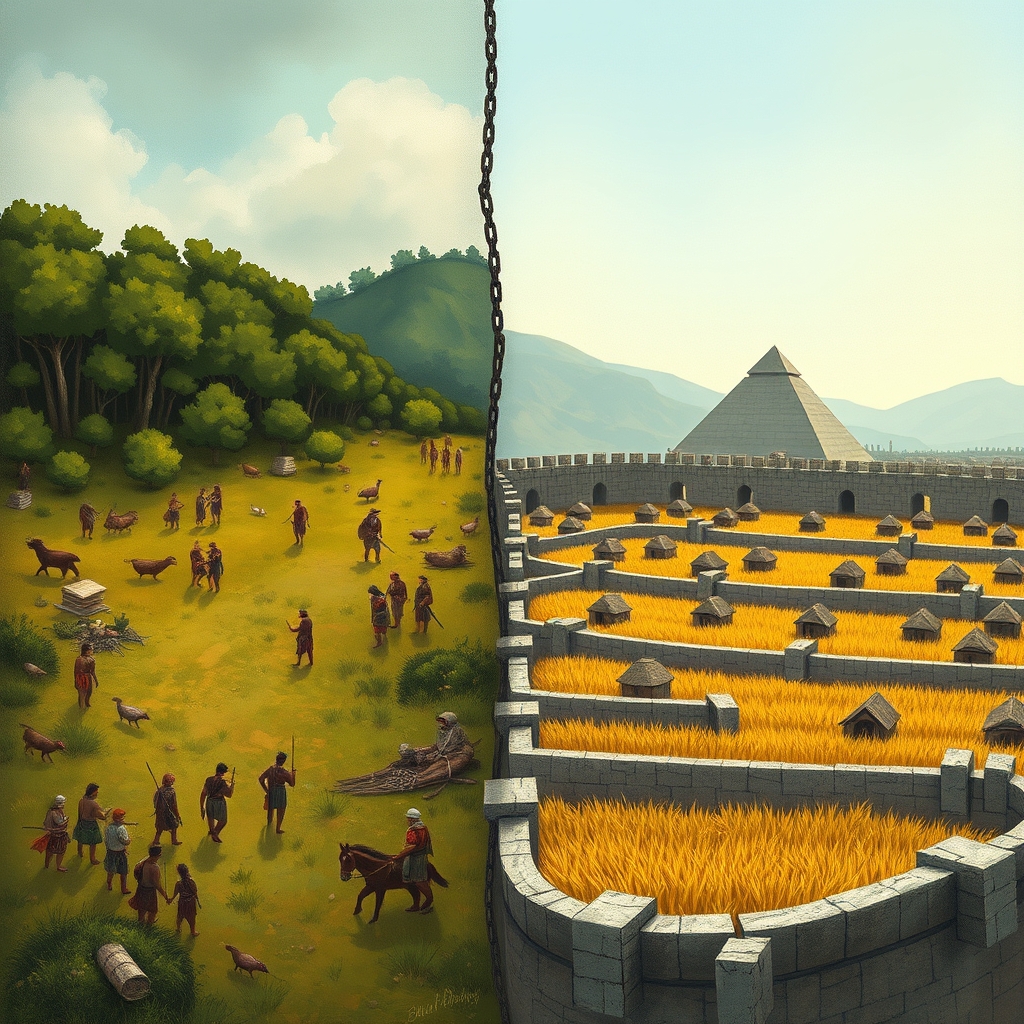
📚 Against the Grain: A Deep History of the Earliest States challenges conventional narratives, arguing that early states were not an inevitable progression to a better life, but rather fragile, coercive prisons that most people actively resisted, only possible due to highly controllable grain agriculture. 🌾⛓️📉
🤖 AI Summary
💡 Core Argument
❌ Standard Narrative Challenged: Sedentism, agriculture, and states did not naturally lead to improved human welfare or civilization; often the opposite.
⛓️ Early States as Coercive: Early states were inherently fragile, often relying on coercion, unfree labor (slavery), and easily taxable cereal grains for their existence.
🏞️ Golden Age of Foragers: Pre-state hunter-gatherer and early sedentary societies often enjoyed better health, more varied diets, and less arduous lives.
⚙️ State Formation Mechanics
🌾 Grain Centrality: Cereal grains (wheat, barley, millet) were crucial for early state formation due to their legibility, storability, and simultaneous ripening, making them ideal for taxation and control.
🏡 Sedentism Precedes Agriculture: Permanent settlements (sedentism) often existed millennia before intensive grain agriculture and state formation.
🧑🤝 Domestication of Humans: State formation involved the domestication of humans themselves, akin to livestock, for labor and tax purposes.
⛏️ Labor Scarcity: Early states faced chronic labor shortages, leading to practices like warfare for captives and slavery to maintain populations.
⛰️ Non-State Peoples (Barbarians)
🏃♂️ Active Avoidance: Many barbarian groups actively resisted or fled state control, preferring mobile subsistence strategies (hunting, gathering, pastoralism, shifting cultivation).
🤝 Symbiotic/Antagonistic Relationship: Non-state peoples maintained complex relationships with states, including trade, raiding, and serving as mercenaries or sources of slaves.
🔓 State Collapse as Liberation: State collapse was often not a disaster for the majority population but an opportunity for freedom, dispersal, and improved living standards.
🌱 Health & Environment
🦠 Disease: Early state-based, dense populations suffered from increased disease (zoonoses, epidemics) due to close quarters with domesticated animals and poor sanitation.
🍎 Malnutrition: Reliance on a narrow range of grain crops led to nutritional deficiencies compared to varied forager diets.
🌍 Environmental Degradation: Intensive, monocrop agriculture by early states contributed to soil salinization and other ecological problems.
⚖️ Evaluation
✨ Provocative Synthesis: Against the Grain is widely praised for synthesizing vast interdisciplinary research (archaeology, anthropology, political science, environmental studies) to present a highly provocative and counter-intuitive narrative.
🚧 Critique of Progress Narrative: The book effectively challenges the long-held teleological view of state formation as an inevitable and beneficial march of progress.
👁️ Emphasis on Legibility and Control: Scott’s focus on the state’s need for legibility through taxable grain and controlled populations aligns with his broader work on state power (e.g., Seeing Like a State).
🏺 Archaeological Support: Recent archaeological findings, indicating sedentism often preceded full-scale agriculture and state formation by millennia, lend strong support to Scott’s arguments.
⚔️ Potential Understatement of Non-State Conflict: Some critics suggest Scott might understate the prevalence and impact of warfare among non-state peoples, potentially painting too idyllic a picture of pre-state life.
🏛️ Limited Scope on Positive Aspects of Civilization: The book is less concerned with the cultural, technological, and societal advancements (e.g., monumental architecture, writing systems) that arose within early states, focusing instead on the costs to the majority.
🙏 Acknowledged Limitations: Scott himself, a political scientist, acknowledges his synthesis of archaeological data and invites further interrogation, particularly regarding the historical claims.
🔍 Topics for Further Understanding
🏗️ The role of monumental architecture in early state legitimization and control.
✊ Specific examples of resistance to early states beyond flight or raiding.
📈 Detailed economic models of non-grain-based early complex societies (e.g., Andean civilizations).
⛈️ The impact of climate change on state formation and collapse in regions outside Mesopotamia (e.g., Mesoamerica, Indus Valley).
📜 The evolution of property rights and land ownership concurrent with state development.
🧠 The psychological and social adaptations of human populations to state-imposed hierarchies and sedentary life.
🔬 The specific mechanisms of zoonotic disease emergence and spread in early agrarian settings.
❓ Frequently Asked Questions (FAQ)
💡 Q: What is the main argument of Against the Grain: A Deep History of the Earliest States?
✅ A: Against the Grain argues that early states, particularly those based on grain agriculture, were fragile, coercive entities that exploited rather than improved the lives of most people, and that many actively resisted or fled state control.
💡 Q: How does Against the Grain challenge the traditional view of civilization?
✅ A: Against the Grain overturns the idea that settled agricultural life and state formation were inherently superior or desired pathways to progress, suggesting that earlier hunter-gatherer and mobile groups often had better health and diets.
💡 Q: Why does James C. Scott emphasize grain in Against the Grain?
✅ A: James C. Scott highlights grain because its concentrated production, simultaneous ripening, and storability made it uniquely suitable for state-level taxation, appropriation, and control of labor, unlike other crops such as tubers.
💡 Q: What does Against the Grain say about barbarians?
✅ A: Against the Grain posits that barbarians were not simply undeveloped peoples, but often individuals or groups who deliberately chose to live outside state control, sometimes having fled oppressive state conditions, and maintained complex, often fluid relationships with states.
💡 Q: Did state collapse necessarily mean disaster, according to Against the Grain?
✅ A: No, Against the Grain suggests that for many subjugated populations, state collapse could be a positive event, leading to liberation, dispersal, and a return to more varied and healthier subsistence strategies.
📚 Book Recommendations
👍 Similar
📖 The Art of Not Being Governed: An Anarchist History of Upland Southeast Asia by James C. Scott
📖 Seeing Like a State: How Certain Schemes to Improve the Human Condition Have Failed by James C. Scott
📖 📜🌍⏳ Sapiens: A Brief History of Humankind by Yuval Noah Harari (for broad scope on human history)
🆚 Contrasting
📖 🔫🦠🔩 Guns, Germs, and Steel: The Fates of Human Societies by Jared Diamond (for a more deterministic, environmentalist view of societal development)
📖 🌅🧑🤝🧑 The Dawn of Everything: A New History of Humanity by David Graeber and David Wengrow (for a critique of linear progression narratives and a focus on diverse societal structures)
🔗 Related
📖 🏛️💰 Debt: The First 5,000 Years by David Graeber (for insights into the origins of economic systems and coercion)
📖 Order Without Law: How Neighbors Settle Disputes by Robert Ellickson (for examining social order outside formal state institutions)
📖 Collapse: How Societies Choose to Fail or Succeed by Jared Diamond (for case studies on societal collapse, though with different framing)
🫵 What Do You Think?
🤔 Do you find Scott’s anti-state perspective on early civilizations compelling, or does it overlook the necessary benefits of state formation? How do these re-interpretations change your view of historical progress?
🦋 Bluesky
🔄📜🏛️ Against the Grain: A Deep History of the Earliest States
AI Q: 🏛️ Was the state a step forward or trap?
🌾 Agriculture & Control | ⛓️ Coercion & Resistance | 🏞️ Forager Lifestyles | 🏛️ State Formation
— Bryan Grounds (@bagrounds.bsky.social) 2026-04-01T11:27:58.000Z
https://bagrounds.org/books/against-the-grain-a-deep-history-of-the-earliest-states