🥀🏛️ The Ruin of the Roman Empire: A New History
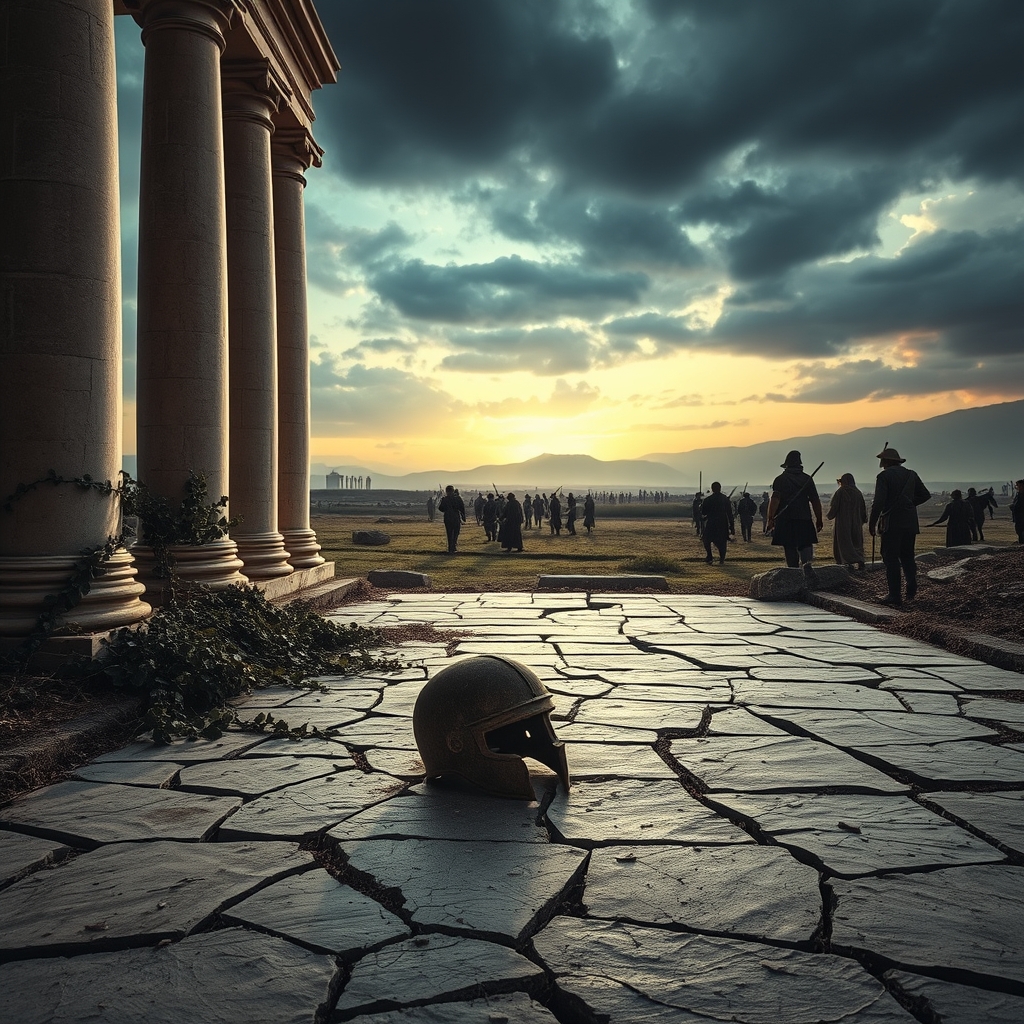
🌍⚔️💔 External Germanic migrations, rather than internal decay, were the decisive factor in the Western Roman Empire’s collapse, leading to a profound transformation of Europe.
🤖 AI Summary
💪 Core Argument: External Pressure Dominance
- 🏹 Primary Cause: Aggressive, large-scale Germanic migrations and their sustained military pressure on Roman frontiers.
- 💪 Barbarian Strength: Barbarian groups, increasingly unified and militarized by Roman interaction, became formidable adversaries.
- 💸 Resource Depletion: Constant warfare and territorial losses severely eroded the Western Empire’s tax base, manpower, and overall economic capacity.
- ❌ Strategic Failure: Roman inability to consistently defeat or integrate these large migratory groups proved fatal.
📉 Roman Response & Consequences
- 🤏 Military Overstretch: Empire stretched thin, unable to defend all frontiers simultaneously against concerted attacks.
- 😬 Internal Strain: Military demands exacerbated existing social and economic tensions, though not as primary drivers of collapse.
- 🧩 Political Fragmentation: Loss of provinces led to fragmentation of imperial authority and emergence of new barbarian kingdoms.
- ⚖️ Eastern vs. Western Fate: The Eastern Roman Empire’s more robust economy and geographically defensible position allowed it to withstand similar pressures, unlike the West.
🔄 Historiographical Shift
- 🚫 Rejection of Internal Decay: Challenges traditional narratives emphasizing internal moral, economic, or political decadence as the primary cause.
- 💥 Focus on Agency: Emphasizes the agency and impact of external barbarian actors in shaping Roman destiny.
⚖️ Evaluation
- ✨ Peter Heather’s thesis, focusing on the external pressure of barbarian invasions as the primary cause of the Western Roman Empire’s collapse, is a highly influential and largely accepted perspective within modern scholarship.
- 🥊 It directly challenges earlier decline narratives, most famously Edward Gibbon’s, which emphasized internal moral decay and the rise of Christianity. While Gibbon’s work remains foundational, Heather’s argument offers a more materialist and geopolitical explanation for the fall.
- 💡 Heather’s emphasis on the growing sophistication and scale of barbarian confederations aligns with contemporary archaeological evidence and re-evaluations of barbarian agency, moving beyond portrayals of disorganized raiders.
- 🧐 Some scholars, while acknowledging the profound impact of external pressures, argue that internal weaknesses—such as political instability, economic disparities, and administrative inefficiencies—made the Empire more vulnerable to these external shocks.
- 🌡️ More recent historical work, notably Kyle Harper’s The Fate of Rome, introduces environmental factors like climate change and pandemics as significant, often overlooked, contributors to the Empire’s weakening, which Heather’s work does not extensively prioritize. These perspectives suggest a multi-causal model, where external invasions acted on an already stressed system.
- 👏 The book is praised for its meticulous research and accessibility, making complex arguments understandable for both specialists and general readers.
🔍 Topics for Further Understanding
- 🎭 The formation and evolution of barbarian identities and polities, pre and post-Roman contact.
- 📈 The economic and social structures of the early Byzantine Empire and its divergence from the West.
- 🌍 The role of climate change, disease, and environmental factors in late antique societal transformations.
- 👑 The development of post-Roman successor kingdoms and their relationship with Roman institutions.
- 📚 The historiography of the Fall of Rome across different eras and its reflection of contemporary anxieties.
❓ Frequently Asked Questions (FAQ)
💡 Q: What is the main argument of The Ruin of the Roman Empire: A New History?
✅ A: The Ruin of the Roman Empire: A New History primarily argues that the Western Roman Empire collapsed due to sustained and increasingly successful external pressures from Germanic barbarian migrations and invasions, rather than internal decline or decay.
💡 Q: How does Peter Heather’s view in The Ruin of the Roman Empire: A New History differ from Edward Gibbon’s?
✅ A: Peter Heather’s view in The Ruin of the Roman Empire: A New History significantly differs from Gibbon’s by asserting that external barbarian invasions were the decisive factor, whereas Gibbon famously attributed the fall to internal moral decay and the rise of Christianity.
💡 Q: Does The Ruin of the Roman Empire: A New History discuss the Eastern Roman Empire?
✅ A: Yes, The Ruin of the Roman Empire: A New History discusses the Eastern Roman Empire, primarily to highlight how its stronger economic base and more defensible geography allowed it to survive the same external pressures that brought down the West.
💡 Q: What role do barbarians play in The Ruin of the Roman Empire: A New History?
✅ A: In The Ruin of the Roman Empire: A New History, barbarians play a central role as increasingly organized, powerful, and effective military forces whose sustained pressure and successful invasions ultimately exhausted and dismantled the Western Roman Empire.
💡 Q: Is The Ruin of the Roman Empire: A New History accessible to non-specialists?
✅ A: Yes, The Ruin of the Roman Empire: A New History is widely considered accessible to non-specialists, offering a clear and engaging narrative despite its academic rigor.
📚 Book Recommendations
🤝 Similar
- 📖 How Rome Fell by Adrian Goldsworthy
- 📖 The Fall of Rome and the End of Civilization by Bryan Ward-Perkins
- 📖 Rome’s Last Citizen by Rob Goodman and Jimmy Soni
🔄 Contrasting
- 📖 The Fate of Rome by Kyle Harper
- 📖 The History of the Decline and Fall of the Roman Empire by Edward Gibbon (for historical context, not modern scholarship)
- 📖 The Collapse of Complex Societies by Joseph Tainter
🔗 Related
- 📖 Framing the Early Middle Ages by Chris Wickham
- 📖 The Myth of Nations by Patrick Geary
- 📖 Inheritance of Rome by Chris Wickham
🫵 What Do You Think?
🤔 Which of the proposed causes for the fall of the Roman Empire resonates most with you, and why? Do you prefer single-cause explanations or multi-faceted theories?