♾️🌿🔬 The Fractal Geometry of Nature
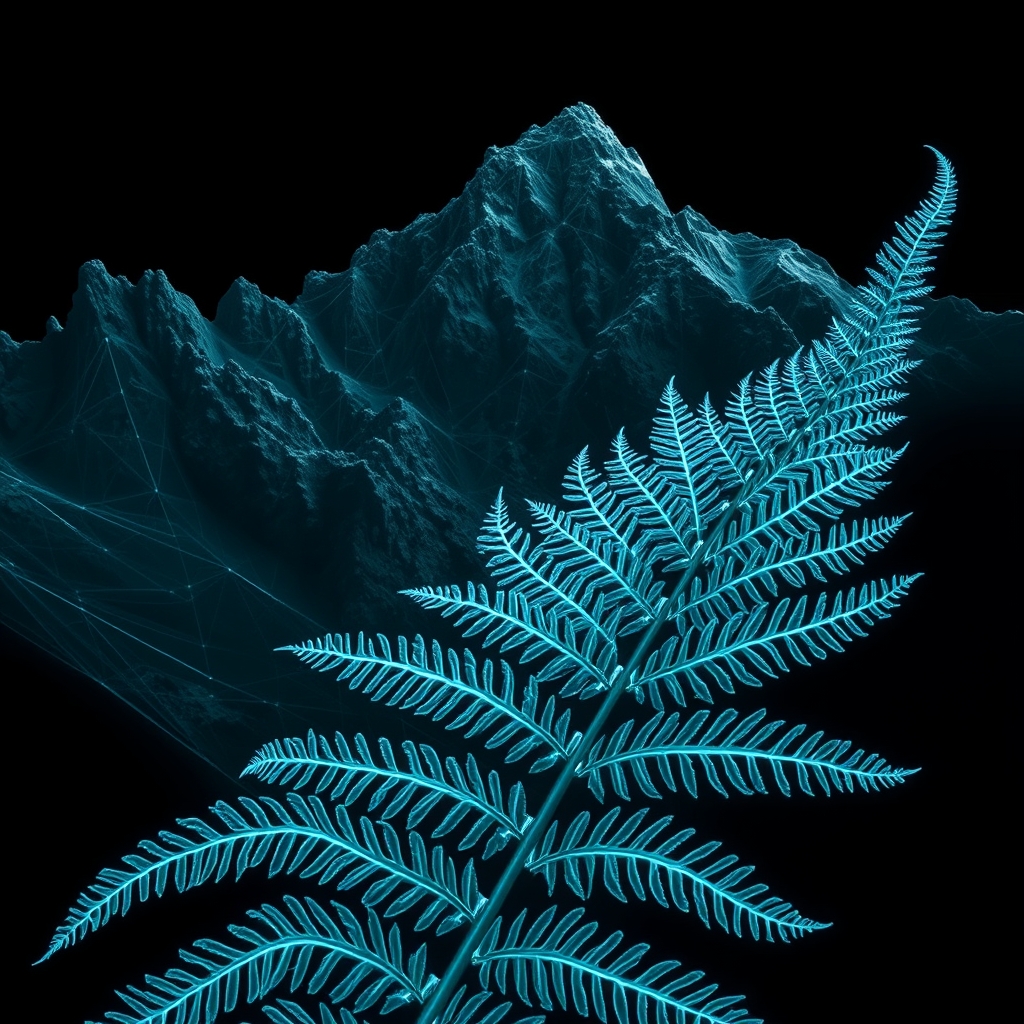
🛒 The Fractal Geometry of Nature. As an Amazon Associate I earn from qualifying purchases.
🤯 Revolutionize your understanding of natural shapes by introducing fractals—infinitely complex, self-similar patterns with non-integer dimensions—providing a mathematical language for the irregularities of 🌳 clouds, 🌊 coastlines, and mountains previously ignored by Euclidean geometry.
🤖 AI Summary
🤖 Core Philosophy
- 📐 Euclidean Limitations: Traditional geometry (lines, circles, spheres) inadequate for natural forms. 🌳 Nature’s shapes are inherently irregular, fragmented, and complex.
- ✨ Fractal Innovation: Fractals provide a mathematical framework to describe and quantify this natural complexity.
- 🔁 Self-Similarity: Key property where parts of an object resemble the whole at different scales. Can be exact (mathematical fractals) or statistical (natural fractals).
- ♾️ Fractal Dimension: A non-integer dimension (e.g., between 1 and 2) that quantifies an object’s space-filling capacity and how its complexity changes with scale.
- 🌍 Ubiquity in Nature: Fractal patterns observed in ☁️ clouds, 🌊 coastlines, 🏞️ river networks, ⚡ lightning, 🌲 trees, ⛰️ mountains, and even 🧬 biological systems.
🔑 Key Concepts & Actionable Insights
- 🔎 Identify Irregularity: Observe natural phenomena for patterns of irregularity and fragmentation at various scales.
- 📏 Quantify Complexity (Fractal Dimension):
- ✍️ Definition: D = log(N) / log(r), where N is number of self-similar pieces, r is magnification factor.
- 📦 Box-Counting Method: Overlay grid, count filled boxes, refine grid, plot log(N) vs log(r); slope reveals dimension. Useful for non-strictly self-similar objects.
- 👀 Recognize Self-Similarity: Look for recurring patterns across magnifications. Distinguish between exact mathematical self-similarity and approximate/statistical natural self-similarity.
- 🌐 Interdisciplinary Application: Apply fractal concepts to diverse fields:
- 🗺️ Geography: 🌊 Coastline length, 🏞️ river networks.
- ⚛️ Physics: 🌪️ Turbulence, 🧱 material structures.
- 🌱 Biology: 🌳 Branching of trees, 🩸 circulatory systems.
- 💹 Economics: 📉 Market fluctuations and volatility.
- 🖥️ Visualize: Utilize computational tools to generate and explore fractal structures (e.g., Mandelbrot set, Julia sets) to gain intuitive understanding.
⚖️ Evaluation
- 🥇 Seminal Work: The Fractal Geometry of Nature is widely considered the foundational work of fractal geometry, synthesizing centuries of mathematical concepts and applying them to natural forms. It popularized the term fractal.
- 🔄 Paradigm Shift: Mandelbrot’s insights profoundly shifted how scientists model the world, moving from idealized Euclidean abstractions to more realistic, complex representations. It was included in American Scientist’s list of one hundred books of 20th-century science.
- 📚 Accessibility vs. Rigor: While the book avoids formal proofs, relegating some to a Mathematical Backup and Addenda, it still assumes a strong mathematical and scientific background, making it challenging for a general audience.
- 💻 Technological Impact: Early visualizations of fractals were limited, but advancements in computing technology have allowed for increasingly detailed and accurate representations, which was crucial for the field’s development and popular appeal.
- 🔗 Connection to Chaos Theory: Fractal geometry is deeply intertwined with chaos theory, describing the underlying geometry of chaotic systems, although fractals themselves are often generated by deterministic rules. Some argue that fractals provide order within seemingly chaotic systems.
- 🚧 Limitations & Evolution: While groundbreaking, some of Mandelbrot’s early terminology did not gain traction. The field has significantly expanded since, with ongoing research in both theoretical fractal mathematics and its diverse applications.
🔍 Topics for Further Understanding
- 🔁 Iterated Function Systems (IFS) and their role in fractal generation.
- 🌿 L-systems (Lindenmayer systems) for modeling plant growth and other biological structures.
- 🔢 Fractional Calculus and its applications in modeling anomalous diffusion and viscoelasticity.
- 🖼️ Applications of fractals in image compression and computer graphics.
- 🕸️ The relationship between fractals, scale-free networks, and complex systems.
- 📊 Multifractal analysis for systems exhibiting varying scaling behavior.
- 🌊 Wavelets and their connection to fractal analysis in signal processing.
❓ Frequently Asked Questions (FAQ)
💡 Q: What is the main idea behind The Fractal Geometry of Nature?
✅ A: The Fractal Geometry of Nature posits that traditional Euclidean geometry is inadequate for describing the irregular and complex shapes found in nature, and introduces fractal geometry as a more appropriate mathematical language for these forms, emphasizing self-similarity and non-integer dimensions.
💡 Q: What is a fractal dimension?
✅ A: A fractal dimension is a statistical index of complexity that quantifies how a fractal pattern changes with the scale at which it is measured, often resulting in a non-integer value (e.g., a coastline might have a dimension between 1 and 2).
💡 Q: What does self-similarity mean?
✅ A: Self-similarity refers to the property where a part of an object resembles the whole, or where patterns repeat at different scales. In nature, this is often statistical (parts show similar properties), while in mathematical fractals, it can be exact.
💡 Q: What are some real-world examples of fractals discussed in The Fractal Geometry of Nature?
✅ A: The Fractal Geometry of Nature discusses examples such as 🌊 coastlines, ☁️ clouds, ⛰️ mountains, 🏞️ river networks, ⚡ lightning, 🌲 trees, and other natural formations that exhibit fractal properties.
💡 Q: How is The Fractal Geometry of Nature related to chaos theory?
✅ A: Fractal geometry provides the geometric framework for understanding many of the complex, irregular patterns that arise from chaotic systems, demonstrating that even unpredictable systems can have underlying ordered structures.
💡 Q: What is the Mandelbrot set, and how is it relevant to fractal geometry?
✅ A: The Mandelbrot set is a famous fractal defined by a simple iterative formula in the complex plane; it showcases infinite complexity and self-similarity, serving as a powerful visual icon and a fundamental object of study within fractal geometry.
📚 Book Recommendations
Similar
- 🌪️💥🦋🆕 Chaos: Making a New Science by James Gleick: Explores the intertwined histories of chaos theory and fractals, detailing the lives and discoveries of key figures.
- Fractals Everywhere by Michael F. Barnsley: A more mathematically rigorous approach to iterated function systems and their applications.
- 💰 The (Mis)Behavior of Markets: A Fractal View of Financial Turbulence by Benoît B. Mandelbrot and Richard L. Hudson: Applies fractal geometry to explain the unpredictable nature of financial markets.
Contrasting
- 📐 Euclid’s Elements by Euclid: The foundational text of classical Euclidean geometry, representing the traditional mathematical perspective that fractal geometry challenges.
- 🤯 Principia Mathematica by Alfred North Whitehead and Bertrand Russell: A monumental work aiming to derive all mathematical truths from a set of axioms, contrasting with Mandelbrot’s empirical and visual approach to mathematics.
Related
- ♾️📐🎶🥨 Gödel, Escher, Bach: An Eternal Golden Braid by Douglas Hofstadter: Explores connections between mathematics, art, and artificial intelligence, touching on recursion and self-reference.
- ⚛️ Complexity: The Emerging Science at the Edge of Order and Chaos by M. Mitchell Waldrop: Provides a broader overview of complexity science, of which fractals and chaos are key components.
- 💻 Structure and Interpretation of Computer Programs by Harold Abelson and Gerald Jay Sussman: Demonstrates how simple computational rules can generate complex, self-similar structures, particularly relevant to understanding fractal algorithms.
🫵 What Do You Think?
🌳 What natural phenomenon do you find most surprisingly fractal, and how has understanding fractal geometry changed your perception of the world around you?