👑⚔️🏛️ Goliath: The 100-Year War Between Monopoly Power and Democracy
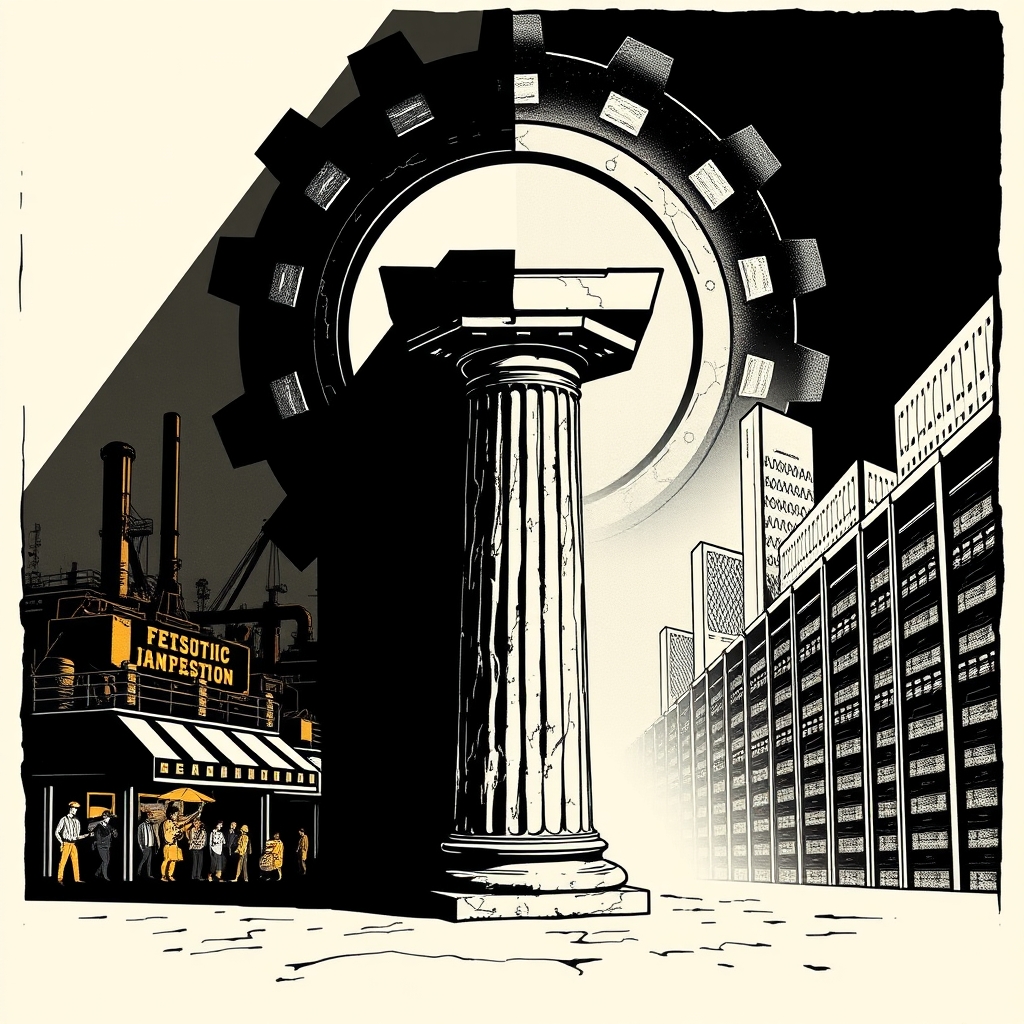
🇺🇸💰💥 A critical examination of the century-long, often hidden, war between concentrated monopoly power and democratic forces in the United States, arguing that the erosion of antitrust enforcement has led to today’s political and economic crises.
🤖 AI Summary
📜 Historical Arc of Monopoly Power vs. Democracy
- 🏛️ Early Republic: Fear of concentrated corporate power; charters for public good, limited duration, revocable.
- 💰 Gilded Age (Late 19th Century): Rise of trusts (e.g., Standard Oil, U.S. Steel); wealth concentration, political corruption.
- ⚖️ Progressive Era (Early 20th Century): Trust-busting presidents (T. Roosevelt, Taft); passage of Sherman Antitrust Act (1890), Clayton Act (1914), FTC Act (1914).
- 🎯 Goal: Promote competition, protect consumers.
- 🌟 Key figures: Louis Brandeis, Woodrow Wilson.
- 🤝 New Deal Era (1930s-1940s): Height of antitrust enforcement; legislation like Robinson-Patman Act (1936).
- 🌟 Democracy of small business achieved.
- 📈 Post-WWII to 1970s: Period of relative economic democracy; strong middle class.
- 📉 Neoliberal Turn (1970s-1980s onwards): Shift towards deregulation; rise of Chicago School economics (consumer welfare standard); weakening of antitrust.
- 🏛️ Reagan administration: Deregulation, anti-union policies.
- 💻 Digital Age (Late 20th Century - Present): Resurgence of monopoly power in tech, finance, retail; increased market concentration.
- 🏢 Examples: Google, Amazon, Facebook, major banks.
🧠 Core Arguments & Concepts
- 💥 Monopoly Power Undermines Democracy: Concentrated economic power leads to concentrated political power, corrupting institutions and suppressing competition.
- 🛡️ Antitrust as a Democratic Tool: Historically, strong antitrust enforcement was essential for a functioning democracy and broad economic opportunity.
- ⚖️ Consumer Welfare vs. Democracy: Critique of the modern antitrust focus on consumer prices, arguing it neglects broader democratic impacts of market concentration.
- 🏢 Government as Enabler/Enforcer: Corporations are chartered by the state and their power is often a result of political decisions and enforcement (or lack thereof) of laws.
- ⚔️ The 100-Year War: A continuous, though often forgotten, struggle between forces seeking to limit concentrated power and those seeking to expand it.
👨💼 Key Figures
- ✊ Antimonopolists: Teddy Roosevelt, Woodrow Wilson, Louis Brandeis, Wright Patman, Franklin D. Roosevelt, John Kenneth Galbraith.
- 💸 Pro-Monopoly/Deregulation Advocates: Andrew Mellon, Robert Bork, Milton Friedman (and the Chicago School).
🌐 Manifestations of Monopoly Power Today
- 📈 Market Concentration: Increased market share for top firms in most industries.
- 📉 Stagnant Wages: Reduced bargaining power for labor.
- 🏛️ Political Influence: Lobbying, campaign finance, regulatory capture.
- 💡 Innovation Stifling: Barriers to entry for new businesses.
- 🏘️ Erosion of Local Economies: Dominance of large chains over small businesses.
🚀 Actionable Insights
- 📚 Understand the History: Recognize that concentrated power is not inevitable but a result of political choices.
- 📣 Advocate for Strong Antitrust Enforcement: Support policies and legislation that break up monopolies and prevent anti-competitive practices.
- 🍰 Promote Person-Sized Chunks: Stoller’s concept of restructuring industries into smaller, more manageable, and competitive units.
- 🌐 Reclaim Economic Democracy: Emphasize that economic power and political power are intertwined; democratic principles should extend to economic structures.
- 🚫 Challenge Narratives of Inevitability: Recognize that the current concentration of power is a political outcome, not a natural economic law.
🔍 Evaluation
- ⭐ Goliath provides a sweeping historical narrative of the ongoing struggle between concentrated economic power and democratic ideals in the U.S..
- 📈 The book effectively illustrates how political decisions, particularly regarding antitrust enforcement, have shaped the landscape of corporate power over the last century.
- 🤔 Stoller argues convincingly that the shift from an antimonopoly tradition to a focus on consumer welfare has contributed to the rise of monopolies and the erosion of democracy.
- 📚 The book’s historical account of antitrust legislation, from the Sherman Act to the Clayton Act and the FTC Act, is well-researched and detailed.
- 🤝 The critique of the Chicago School of Economics and its influence on antitrust thinking is central.
- 📊 The argument that market concentration is a long-run feature of industrial development, as theorized by Marx and Lenin, is supported by recent data showing persistent increases in concentration across many U.S. industries.
- 💡 While the book highlights the historical successes of antitrust, it offers fewer concrete solutions for the present day, leaving some readers wanting more prescriptive guidance.
🌌 Expansion
- ⚖️ The historical evolution of corporate personhood and its implications for corporate rights and responsibilities.
- 📜 The role of intellectual property law and patents in fostering or hindering market concentration.
- 🌍 Comparative antitrust approaches in other major economies (e.g., European Union) and lessons learned.
- 🌐 The impact of globalization and international trade agreements on domestic market concentration.
- 📱 The development and implications of platform monopolies in the digital economy and potential regulatory frameworks.
- 💸 The relationship between financialization, debt, and the consolidation of corporate power.
- 🛠️ The effectiveness of various antitrust remedies (e.g., structural separation, conduct remedies) in addressing modern market power.
- ✊ The historical role of labor movements and unions as countervailing powers against corporate monopolies.
💡 Q: What is the central argument of Matt Stoller’s Goliath: The 100-Year War Between Monopoly Power and Democracy?
✅ A: The central argument is that the United States has been engaged in a century-long, often obscured, struggle between concentrated monopoly power and democratic principles, and that the weakening of antitrust enforcement has allowed monopolies to undermine democracy and economic opportunity.
💡 Q: How does Goliath: The 100-Year War Between Monopoly Power and Democracy define monopoly power?
✅ A: Stoller defines monopoly power broadly, encompassing not just single firms dominating markets but also significant concentrations of economic and financial power that exert undue influence over politics, labor, and everyday life.
💡 Q: What historical periods does Goliath: The 100-Year War Between Monopoly Power and Democracy cover?
✅ A: The book traces this struggle from the Progressive Era and the trust-busting of the early 20th century, through the New Deal, the post-war period of relative economic democracy, and into the rise of neoliberalism and the digital age of tech giants.
💡 Q: What is the consumer welfare standard that Goliath: The 100-Year War Between Monopoly Power and Democracy critiques?
✅ A: The consumer welfare standard, dominant in modern antitrust thinking, focuses primarily on consumer prices as the main indicator of market health. Stoller argues this narrow focus neglects broader harms of monopoly power, such as its impact on political liberty, economic opportunity, and democratic governance.
💡 Q: Does Goliath: The 100-Year War Between Monopoly Power and Democracy offer solutions to combat monopoly power?
✅ A: While the book details historical successes and advocates for a renewed antimonopoly tradition, some reviewers note that it could offer more explicit or detailed solutions for contemporary challenges, focusing more on the historical narrative and critique.
📚 Book Recommendations
📚 Similar Books
- 📘 The New Industrial State by John Kenneth Galbraith: Argues that large corporations exercise significant control over market and government policy.
- 👹 The Promises of Monsters: A Radical Theology of Difficulty by Kelly J. Baker: Explores how challenging conventional notions of power and progress can lead to transformative change, echoing Stoller’s critique of dominant narratives.
- 🐘 Anatomy of the Elephant: The Rise of Corporate Power and the Struggle for Democracy by John Weeks: Provides a historical and critical analysis of corporate power’s influence on democratic societies.
📖 Contrasting Books
- 🏛️ Antitrust: Taking on Monopoly Power from the Gilded Age to the Digital Age by Amy Klobuchar: Offers a contemporary, policy-focused approach to antitrust, often aligning with Stoller’s concerns but from a legislative perspective.
- ⚖️ The Antitrust Paradox by Robert H. Bork: A foundational text for the consumer welfare standard, which Stoller’s work critically engages with and challenges.
🔗 Related Books
- 🪖 David and Goliath: Underdogs, Misfits, and the Art of Battling Giants by Malcolm Gladwell: While exploring different themes, it touches on how perceived disadvantages can become strengths and how the powerful are not always as strong as they seem, offering a different lens on power dynamics.
- 🕰️ The History of Corporate Power (various authors/sources): Deeper dives into the legal and historical evolution of corporations and their influence.
- 🤝🏛️ Team of Rivals: The Political Genius of Abraham Lincoln by Doris Kearns Goodwin: Provides context on how political coalitions can be formed and managed, relevant to the historical battles over economic policy.
🫵 What do you think?
💬 What historical periods or figures in the fight against monopoly power resonate most with you? Which modern industries are concentrated and what policy changes could restore balance?