🫂🏙️🗣️ Everything for Everyone: An Oral History of the New York Commune, 2052–2072
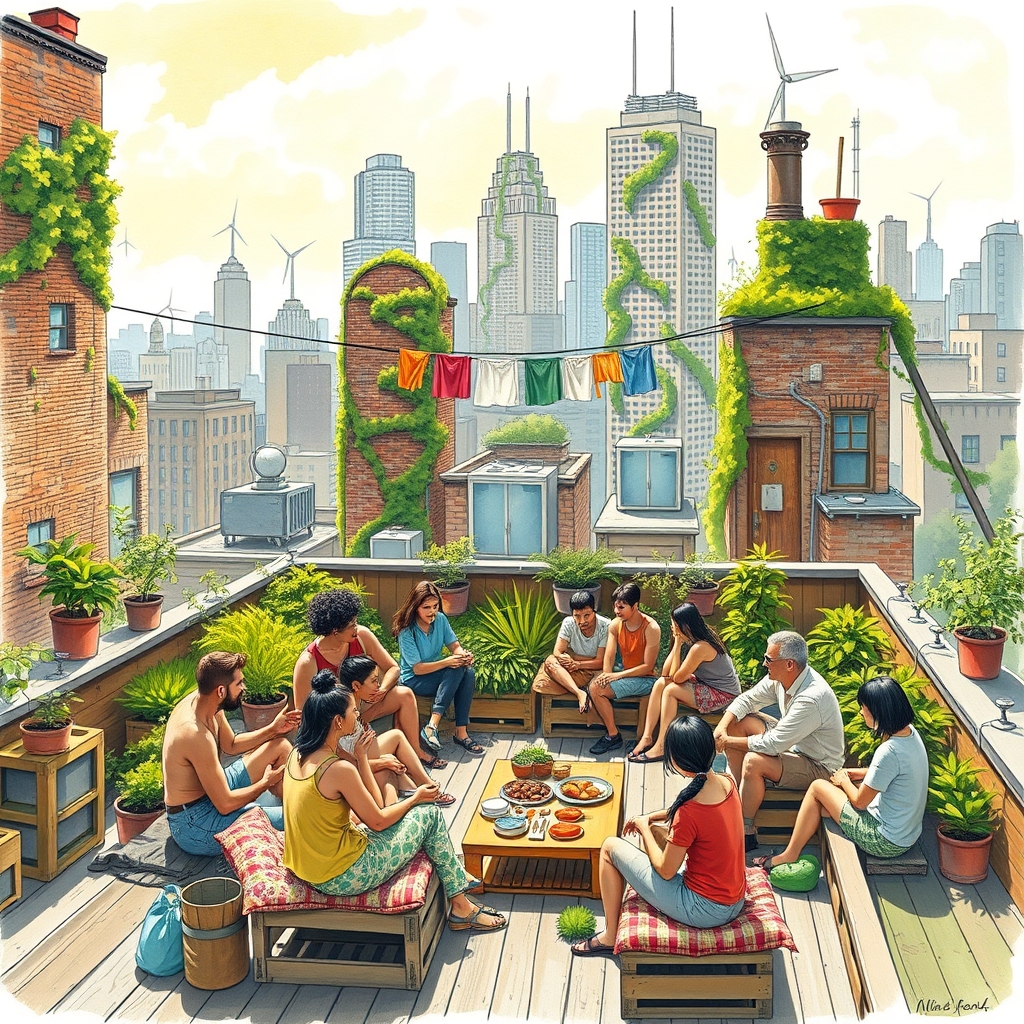
✨🌆🌍 A speculative oral history chronicling a post-capitalist, communal New York City born from global collapse and a successful social revolution, exploring themes of collective survival, liberation, and ongoing societal transformation through diverse personal accounts.
🤖 AI Summary
📚 Book Overview
- 📝 Form: Fictional oral history, collection of interviews (2067-2072) with diverse New Yorkers.
- 🏙️ Setting: New York City and global context, 2052-2072, following capitalist collapse, climate catastrophe, and wars.
- 🎯 Purpose: Imagine a plausible, hopeful post-capitalist future; counteract anti-utopianism.
🤝 Core Tenets of the New York Commune
- 💰 Economy: Post-market, post-money, post-wages, post-commodity form. Needs met for everyone (housing, food, clothing, shelter).
- 🗳️ Governance: Radically new social order, real democracy. Insurrections as a form of commune. Rejection of nation-state.
- 👨👩👧👦 Social Structures:
- 🏡 Family: First stages of family abolition, collective parenting, teenage creches.
- 🏳️🌈 Gender/Sexuality: Gender transformation and liberation, queer and trans experiences integrated.
- ⚖️ Justice: Restorative justice, healing from trauma.
- 👷 Labor: Individuals split labor between community needs and personal development; not single jobs.
- 🌍 Global Context: Revolution begins in Palestine, Andes; spreads worldwide as nation-states fall. Indigenous land struggles and decolonization are central.
- 🚧 Challenges: Deals with trauma, grief, and ongoing struggles against residual fascist and authoritarian enclaves. Messy, imperfect, but fulfilling collective life.
⚖️ Evaluation
- 🌟 Genre Innovation: Praised for its believable, human, and heartbreaking vision of a post-capitalist future, challenging conventional anti-utopian narratives. It’s noted as one of few English science fiction books to detail an effective revolution.
- 📜 Narrative Effectiveness: The oral history format is generally well-executed, making the story feel like an outgrowth of our own time and engaging readers through curiosity about how bad things were and how they have been fixed. The authors (M. E. O’Brien and Eman Abdelhadi) appear as older versions of themselves, facilitating the interviews.
- 🧠 Thematic Depth: Offers a deep examination of scarcity, war, trauma, racism, settler-colonialism, gender, sexuality, child-rearing, restorative justice, and ecological restoration. It portrays a nuanced revolutionary society in flux, avoiding simplistic solutions.
- 🔭 Comparison to Speculative Fiction: Unlike some leftist utopias that feel removed by centuries or technology (e.g., Kim Stanley Robinson’s 2312 or Le Guin’s The Dispossessed), Everything for Everyone aims for a more immediate, relatable, and humanly challenging future. It employs speculative fiction to make the cognitively estranging referent of communism imaginable.
- 🧐 Critique of Society: The book acts as a fictional critique, similar to how dystopian fiction allows exploration of complex societal issues from a detached perspective, fostering critical thinking about social structures. It avoids depicting a scientifically rigorous dystopia, instead showing how human agency can transform circumstances.
🔍 Topics for Further Understanding
- 📊 Detailed economic models and resource allocation mechanisms within the Commune beyond basic needs.
- ⚙️ The evolution of technology and its role in communal life and ecological restoration.
- 🗺️ Specifics of the global revolutionary movements in the Andes, Maghreb, Levant, and Mississippi River Delta.
- 💔 The long-term psychological impacts of the pre-commune collapse and ongoing healing processes.
- 👪 The precise mechanisms and challenges of family abolition and its societal integration.
- 🤝 Interaction and diplomatic relations between the Commune and any remaining non-communal entities or states.
- 🌳 Ecological restoration projects and interplanetary technologies in greater detail.
❓ Frequently Asked Questions (FAQ)
💡 Q: What is Everything for Everyone: An Oral History of the New York Commune, 2052–2072 about?
✅ A: Everything for Everyone: An Oral History of the New York Commune, 2052–2072 is a speculative fiction novel presented as a collection of interviews from the future, detailing how New York City transformed into a post-capitalist commune after global societal collapse, climate catastrophe, and revolution.
💡 Q: Who are the authors of Everything for Everyone: An Oral History of the New York Commune, 2052–2072?
✅ A: The book was co-written by M. E. O’Brien and Eman Abdelhadi. They appear as fictionalized, older versions of themselves conducting the interviews within the book.
💡 Q: What themes does Everything for Everyone: An Oral History of the New York Commune, 2052–2072 explore?
✅ A: Everything for Everyone: An Oral History of the New York Commune, 2052–2072 explores themes such as collective survival, the abolition of capitalist structures (money, wages, nation-states), gender liberation, collective parenting, restorative justice, ecological restoration, and the ongoing struggles of revolutionary change.
💡 Q: Is Everything for Everyone: An Oral History of the New York Commune, 2052–2072 a utopian novel?
✅ A: While presenting a hopeful vision of a better society, Everything for Everyone: An Oral History of the New York Commune, 2052–2072 explicitly portrays a messy, imperfect revolutionary society in flux, acknowledging trauma and ongoing challenges, rather than a simplistic utopia.
💡 Q: What is the significance of the oral history format in Everything for Everyone: An Oral History of the New York Commune, 2052–2072?
✅ A: The oral history format in Everything for Everyone: An Oral History of the New York Commune, 2052–2072 provides diverse, deeply human perspectives on the revolution and communal life, allowing for a polyphonous account that emphasizes lived experience and the complexities of social transformation.
📚 Book Recommendations
📖 Similar
- 🌌 A Memory Called Empire by Arkady Martine (Complex future societies, political intrigue)
- 💸 Walkaway by Cory Doctorow (Post-scarcity, anti-capitalist communes)
- 📅 2312 by Kim Stanley Robinson (Sweeping vision of future society, climate change)
- 🧟 World War Z by Max Brooks (Fictional oral history, post-catastrophe societal rebuild)
- 🎤 Daisy Jones & The Six by Taylor Jenkins Reid (Fictional oral history, character-driven narrative)
↔️ Contrasting
- 🫅 The Handmaid’s Tale by Margaret Atwood (Dystopian authoritarianism, gender oppression)
- 👁️ 1984 by George Orwell (Totalitarian control, suppression of individuality)
- 🏘️ Commune: The Cultural History of America’s Happiest Lands by Richard Fairfield (Non-fiction, historical challenges of communal living)
🔗 Related
- 🦋♟️ Emergent Strategy: Shaping Change, Changing Worlds by adrienne maree brown (Non-fiction, social justice, collective liberation)
- 🌆 The Right to the City by Henri Lefebvre (Urban theory, social production of space)
- 🧙 Caliban and the Witch by Silvia Federici (Feminist history, primitive accumulation, social reproduction)
- 🇵🇸 Palestine’s Children: Returning to Haifa and Other Stories by Ghassan Kanafani (Palestinian liberation narratives)
🫵 What Do You Think?
🤔 Which aspects of a future New York Commune do you find most compelling, and which present the greatest challenges for human nature? How might an oral history approach uniquely shape our understanding of possible futures?