⚙️⛓️ Discipline and Punish: The Birth of the Prison
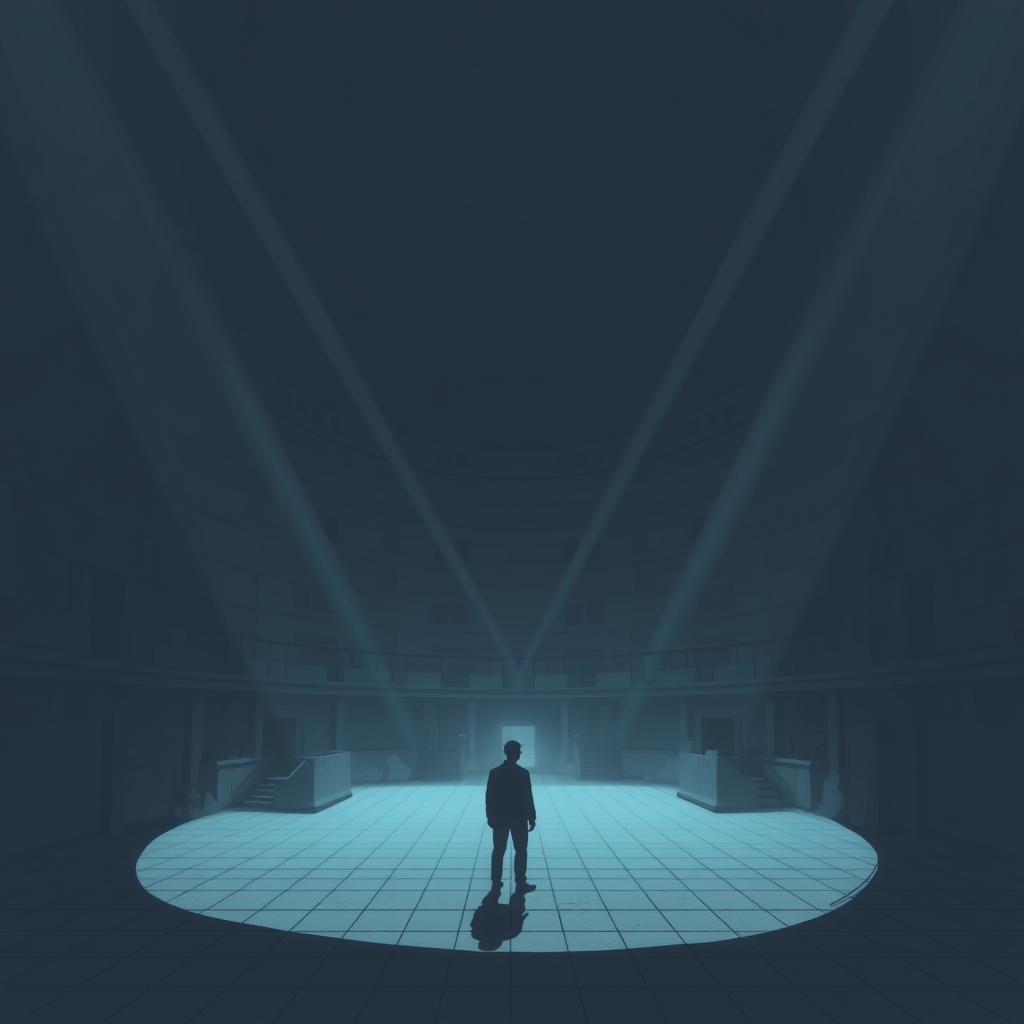
🧐⛓️🏫 Chart the transition from brutal public spectacle punishment to a pervasive, invisible disciplinary power that shapes individuals into docile bodies through constant surveillance and normalization, extending far beyond the prison walls into all modern institutions.
🤖 AI Summary
🎯 Core Argument
- ➡️ Punishment Evolution: Shift from sovereign’s violent, public spectacle of torture (targeting body) to gentle, private forms of control (targeting soul/mind).
- 👀 Disciplinary Power: Modern power operates not primarily through repression but through subtle, pervasive techniques of observation, normalization, and examination.
- 🔗 Power/Knowledge: Inseparable relationship; knowledge (e.g., human sciences like criminology, psychology) is produced by and reinforces power structures, and vice-versa.
- 🧍♂️ Docile Bodies: Disciplinary mechanisms aim to produce individuals who are trained, adaptable, and controllable, suitable for modern industrial, military, and educational systems.
- 👁️ Panopticism: Jeremy Bentham’s Panopticon prison design serves as a metaphor for an omnipresent, invisible surveillance system where individuals internalize the gaze, self-regulating their behavior.
📜 Historical Trajectory
- 🗡️ Pre-18th Century: Public execution, corporal punishment, and torture were key, re-establishing the king’s authority through ceremonial violence on the body.
- 🕰️ 18th Century Reforms: Not purely humanitarian; driven by desire for more efficient and predictable power mechanisms. Transition towards gentle punishment.
- ⛓️ Birth of the Prison: Emerged from disciplinary logic, aiming to deprive freedom and reform the individual, creating the delinquent category.
- 🚨 Carceral System: Encompasses prisons, their regulations, and staff, extending into wider society, aiming to control crime by producing delinquency.
⚙️ Mechanism of Control
- 👀 Hierarchical Observation: Constant, though often invisible, gaze.
- 📏 Normalizing Judgment: Evaluation against established norms, classifying individuals as normal or deviant.
- 📝 Examination: Combining observation and normalization to constitute individuals as cases.
- ⏰ Spatial/Temporal Regulation: Strict control of movement, time, and activities (e.g., timetables, ranks).
⚖️ Evaluation
- 📚 Historical Analysis: Foucault masterfully documents the historical shift in penal practices, from public torture to the modern prison system, providing a unique lens on power dynamics. His use of historical documents from France is extensive.
- 🧠 Power-Knowledge Nexus: The concept of power and knowledge being inextricably linked is widely accepted as a profound contribution to social theory, influencing criminology, sociology, and critical theory.
- 👁️ Panopticon as Metaphor: The Panopticon is recognized as a powerful and enduring metaphor for modern surveillance and social control, applicable to various institutions beyond prisons, including schools and workplaces, and increasingly relevant in the digital age.
- 🤔 Critique of Humanism: Foucault challenges the idea that penal reforms were solely driven by humanitarian concerns, arguing they were also about making power more efficient and effective.
- ❌ Historical Distortion: Some critics argue Foucault occasionally distorts historical details or presents utopian ideals of reformers as actual practices, potentially undermining the practical relevance of his social analysis.
- ✊ Lack of Agency/Solutions: A common criticism is that Foucault’s framework can be seen as deterministic, failing to adequately account for individual agency, resistance, or offering concrete solutions to the systems he critiques.
- 🗣️ Focus on Discourse: Foucault is sometimes criticized for focusing on the discourse of prisons rather than their concrete, lived practice.
🔍 Topics for Further Understanding
- 📱 Digital Panopticism and Surveillance Capitalism
- 🧬 Biopolitics and Governmentality (Foucault’s later work)
- 💰 The Prison Industrial Complex and its economic implications
- 🤝 Restorative Justice and alternative models of punishment
- 🏢 Total Institutions (Erving Goffman) and their intersection with Foucauldian discipline
- 🌈 Foucault’s influence on queer theory and gender studies
❓ Frequently Asked Questions (FAQ)
💡 Q: What is the main argument of Discipline and Punish: The Birth of the Prison?
✅ A: Discipline and Punish argues that Western penal systems shifted from public torture and execution to disciplinary institutions like prisons, not primarily out of humanitarianism, but as a more efficient and pervasive form of social control that aims to reform the soul rather than merely punish the body.
💡 Q: What is the Panopticon, and why is it important in Discipline and Punish?
✅ A: The Panopticon is a theoretical prison design by Jeremy Bentham, where a single observer can see all inmates without being seen. Foucault uses it as a metaphor for panopticism, a mode of social control where the possibility of constant surveillance leads individuals to internalize the gaze and self-regulate their behavior, creating docile bodies in society.
💡 Q: What does Foucault mean by power-knowledge in Discipline and Punish?
✅ A: In Discipline and Punish, Foucault argues that power and knowledge are inseparable; there is no power relation without a corresponding field of knowledge, and no knowledge that doesn’t presuppose and constitute power relations. Knowledge, particularly from the human sciences, provides the tools and categories for power to observe, classify, and control individuals.
💡 Q: Is Discipline and Punish a historical account or a philosophical critique?
✅ A: Discipline and Punish is both a historical analysis of penal systems and a philosophical critique of the underlying power structures. Foucault employs a genealogical method to trace historical transformations while simultaneously theorizing how power operates in modern society.
💡 Q: How is Discipline and Punish relevant today?
✅ A: Discipline and Punish remains highly relevant today, offering insights into modern surveillance (digital panopticism), the functioning of institutions like schools and workplaces, and the subtle ways societal norms and power shape individual behavior and identity.
📚 Book Recommendations
➕ Similar
- 📖 Madness and Civilization by Michel Foucault
- 📖 The History of Sexuality, Vol. 1: An Introduction by Michel Foucault
- 📖 The Order of Things by Michel Foucault
- 📖 Are Prisons Obsolete? by Angela Y. Davis
➖ Contrasting
- 📖 The Crisis of Imprisonment by Rebecca M. McLennan
- 🛑👮 The End of Policing by Alex S. Vitale
- 📖 On the Genealogy of Morality by Friedrich Nietzsche
➡️ Related
- 📖 The Medium is the Massage by Marshall McLuhan, Jerome Agel, and Quentin Fiore
- 📖 Total Institutions by Erving Goffman (related concept)
- 📖 We by Yevgeny Zamyatin (dystopian novel with panoptic themes)
- 👁️ 1984 by George Orwell (explores omnipresent surveillance)
🫵 What Do You Think?
💬 Which of Foucault’s concepts from Discipline and Punish do you find most unsettling in contemporary society? Does his analysis of power leave room for effective resistance or change?