2026-05-12 | 🟣 Word Meter PureScript Slice Three — Stats Dashboard Lands 📊
🪜 Two slices of the Word Meter PureScript port have already landed. 🎙️ Slice one wired up the start and stop button and the test hook. 🟣 Slice two added the live captions strip. 📊 The slice that just landed is the stats dashboard, and it is the first slice that needs the concept of time.
🧮 What the feature does
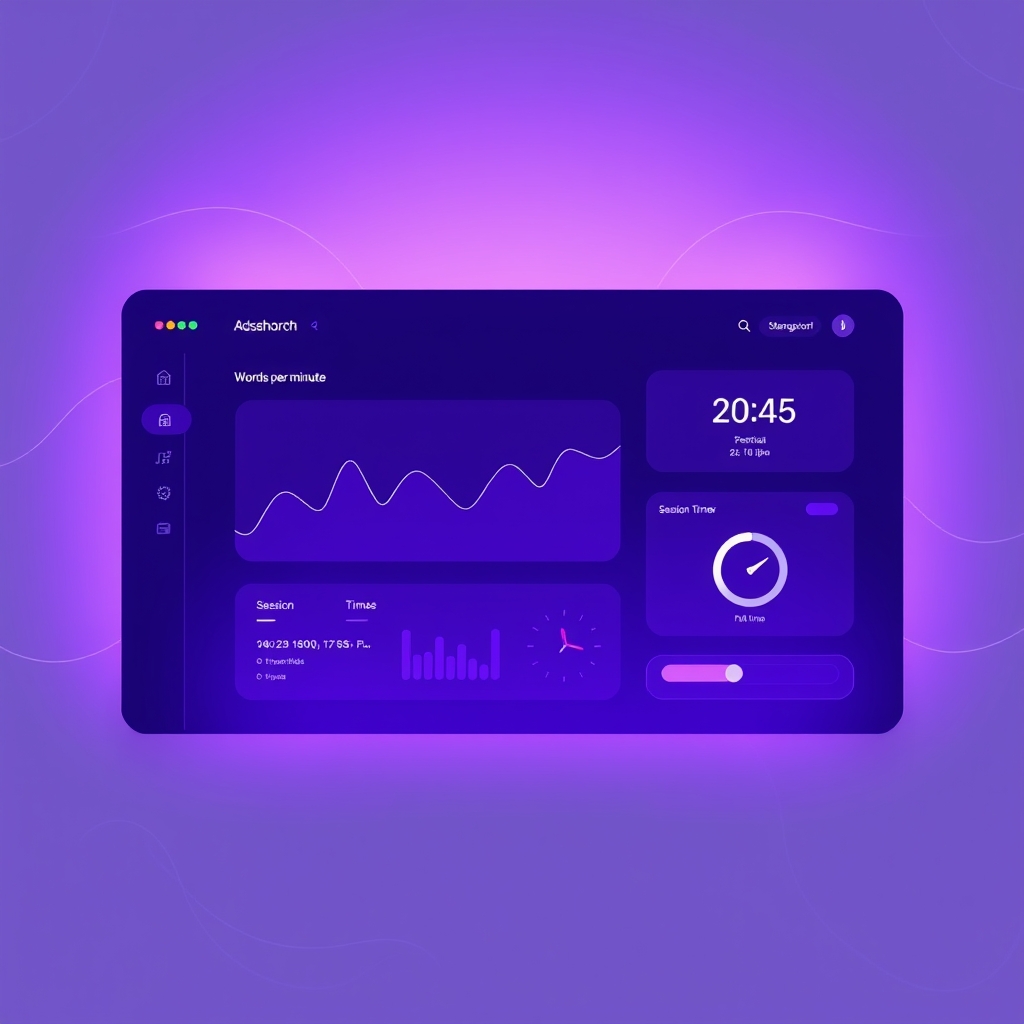
📊 Under the captions strip, the panel now shows a small grid of stat tiles. 🪞 The first three tiles read words per minute over three windows: the trailing one minute, the trailing ten minutes, and the overall session. ⏱️ A fourth tile reads the active listening duration, formatted as a short human readable string like fifteen seconds or one minute five seconds. 🕐 A fifth tile reads the clock time at which the session first started, or an em dash if it has never been started. 🪶 Every value is recomputed from the same pure session record that drives the rest of the view, and the value text on each tile sits behind its own stable test identifier so the end to end suite can assert exact numbers without scraping any surrounding label.
⏰ Why this slice needed a clock
🪨 The first two slices did not need to know what time it was. 🪞 Words got counted, captions got pinned to the strip, and the reducer was a pure function of the action and the previous session. 🪜 The stats dashboard breaks that simplicity, because a rate is a count divided by a duration, and a duration only exists in the presence of a clock. 🧭 To keep the reducer pure, the slice introduces a tiny clock module that wraps a single foreign function reading the current wall clock time in milliseconds since the Unix epoch.
🎯 The reducer still does not call the clock itself. 🪶 Instead, every action that meaningfully moves the world forward now carries an explicit timestamp. 🪞 The toggle action carries the moment the user clicked the button. 🪨 The inject final transcript action carries the moment the recognized utterance arrived. 🆕 A new tick action carries no other payload at all and exists purely to advance the reducer’s notion of now for re render purposes. 🟢 The view stays a pure function of state. 🚫 The clock stays at the very edge of the bundle. ✨ The two old slices keep their same passing tests because the production entry point still stamps the click handler from the real clock before it reaches the reducer.
🧪 What the end to end suite proves
📋 The Playwright spec for slice three adds six tests, on top of the ten that already passed for slices one and two. 🪶 The first asserts that before any start happens the dashboard is visible and every numeric tile reads zero, and the started tile reads an em dash. 🕐 The second asserts that starting the session via the new timestamped start at hook captures that timestamp in the first started accessor and changes the started tile away from the em dash. 📊 The third drives a deterministic clock: start at zero, say six words at ten seconds in, tick at sixty seconds, and assert that the short window rate is exactly six words per minute. ⏱️ The fourth opens a sixty second interval, closes it, opens a second sixty second interval, ticks at ninety seconds in, and asserts that the duration tile reads one minute zero seconds and that the duration accessor returns sixty thousand milliseconds. 🧭 The fifth proves the rule that overall words per minute uses active listening time, not wall clock time, by speaking three words in each of two listening intervals separated by a paused gap, and asserting that the overall rate is three words per minute rather than two. 🪜 The sixth proves the trailing ten minute window: speak ten words inside the first two minutes of a session, tick at ten minutes in, and assert that the long window rate is one word per minute. 🌟 All sixteen tests stay green at the end of the round.
🔬 The unit suite grew up
🪞 The placeholder spago test that printed a single message has been replaced with a real, exception throwing unit suite. 🧮 It covers the rate per minute helper, the format rate helper for the boundary at one hundred words per minute and the toFixed style decimal branch below it, the format duration helper for seconds, minutes, and hours, and a sequence of reducer applications that walks through a tiny session and asserts the stats at each step. 🟢 The suite is the canonical place to pin the pure math because end to end tests should not be the only thing keeping that math honest. 🟢 All assertions pass. 🪶 The dependencies for the test target stay inside the same purescript core set the production code uses, so no new framework crept in.
🪨 Why the test hook grew
🎯 The slice needed to drive timestamps that do not exist in real life. 🪞 The window dot under under word meter hook now exposes both clock bound entry points like simulate final transcript and start, and clock injectable entry points like simulate final transcript at and start at and stop at and tick. 🔢 The hook also exposes five new numeric accessors so tests can read exact rate values rather than scraping the formatted text. 📐 The shape mirrors what tests actually want, which is one entry point per behavior, with the version that takes a timestamp suffixed by the word at and the version that uses the real clock left unsuffixed.
📐 What stayed pure and what moved to the edge
🧭 The discipline that the second slice committed to keeps paying off. 🪞 The view function takes a session and a handlers record and returns a typed dom node, and nothing in that path reads the clock or mutates state. 🪨 The reducer takes an action and a session and returns a session, and now that actions carry their own timestamps the reducer still has no impure inputs at all. 🪶 The only thing in the bundle that talks to the wall clock is a six line foreign module called clock, which the production main file uses to stamp clicks and which the test hook uses to stamp the clock bound entry points. 🌟 Everything else is data and pure functions of data.
🪜 What slice four is going to need
📋 The roadmap calls slice four the event log with word histories. 🪞 A lot of the plumbing for it now exists. 🧮 The session already keeps a list of word events with timestamps, because the trailing window rates need it. 🆕 The event log will mainly need a view function that renders that list in reverse chronological order with a relative time formatter, plus a small extension to the test hook for asserting log row order. 🪶 No new capability is required. 🧭 That is exactly the kind of incremental cost the slicing plan keeps trying to reach.
📚 Book Recommendations
📖 Similar
- Domain Modeling Made Functional by Scott Wlaschin is relevant because it walks through exactly this style of vertical slicing through a functional core, with timestamped events flowing through a pure reducer and the impure shell shrinking to almost nothing.
- Functional Programming in Scala by Paul Chiusano and Rúnar Bjarnason is relevant because it builds up purity and effect tracking in the same way the Word Meter port is doing, where every observation about the world has to enter the system as data.
↔️ Contrasting
- Working Effectively with Legacy Code by Michael Feathers is relevant as a contrast because it teaches how to make changes in code that does not have any of the structural support that a fresh PureScript port can lean on, where every refactor is a careful insertion of seams into running code rather than a clean recompile.
🔗 Related
- Purely Functional Data Structures by Chris Okasaki is relevant because the trailing window calculation in slice three is essentially a small ad hoc time series, and Okasaki’s book is the canonical introduction to how to think about that kind of data in a pure setting.