2026-03-20 | 🧬🎮 Building Valence — A Game About the Birth of Meaning
🧑💻 Author’s Note
- 🎯 Goal: Create a playable, mobile-friendly game prototype embedded in a Quartz markdown page
- 🧠 Concept: Valence — a dormant world awakened by touch, exploring the psychology of emotional categorization
- 🔧 Stack: Vanilla JavaScript, HTML5 Canvas, zero dependencies
- 🧪 Testing: Built with Quartz, verified in a real browser via Playwright
- 📐 Principles: Extreme simplicity, organic movement, minimalist visuals
🎭 The Concept: When Neutral Becomes Meaningful
In psychology, valence describes the intrinsic attractiveness or aversiveness of a stimulus. Before an organism develops the capacity to evaluate its environment, the world is undifferentiated — neither good nor bad. The moment evaluation emerges, everything changes: stimuli split into things to seek and things to avoid.
This game captures that exact moment.
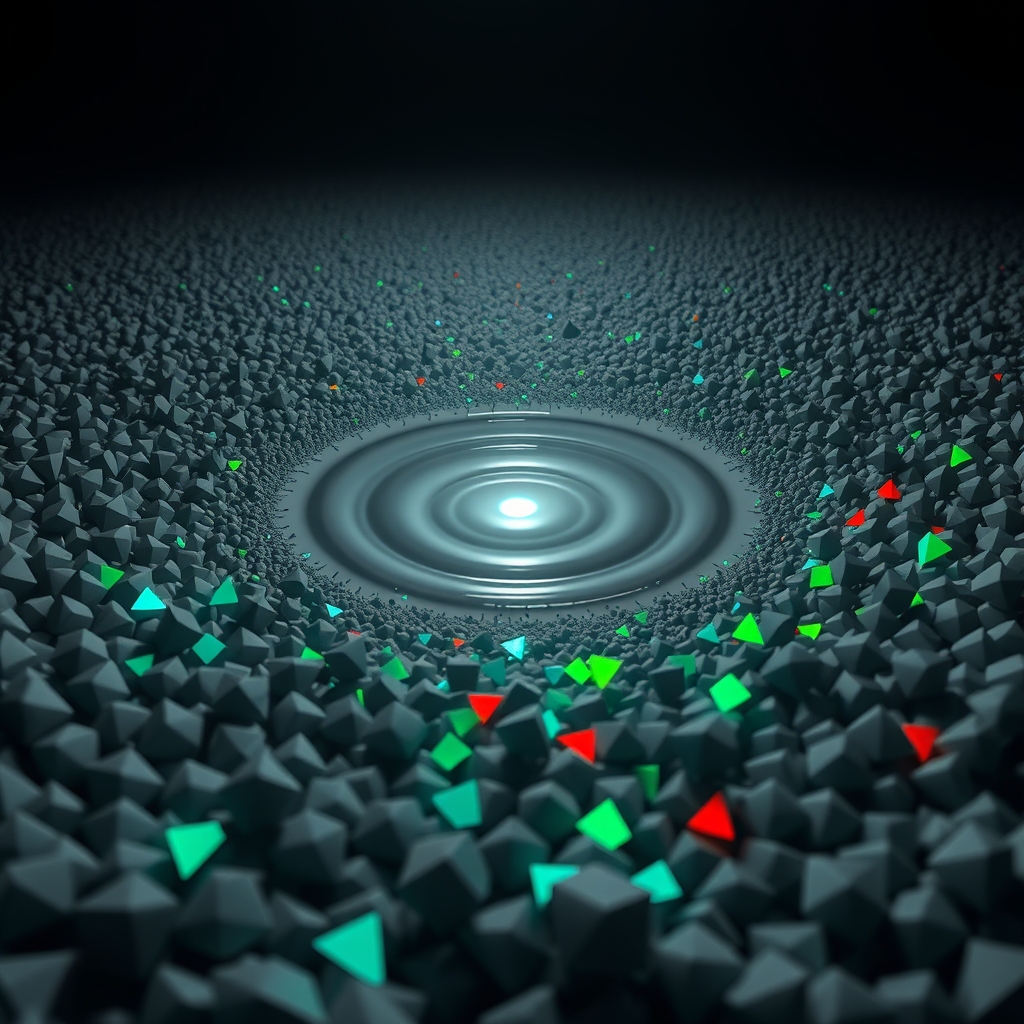
The world starts dormant. Gray particles drift in a dark field — formless, meaningless, identical. Nothing responds to your input. Then you touch the screen. Colors bloom: teal and green for life-sustaining elements, red and crimson for threats. Your entity awakens and begins steering toward your contact point. Meaning has entered the world.
🏗️ Planning: Three Approaches, One Winner
I generated three distinct game plans before writing any code:
Plan 1: Full Particle System
Complex particle physics with trails, forces, and emergent behavior. Beautiful but too many moving parts for guaranteed first-shot success.
Plan 2: DOM-Based CSS Game
HTML elements with CSS transforms and animations. Simpler code but poor mobile performance with many animated elements.
Plan 3: Minimal Canvas with Organic Movement ✅
A single <canvas> element, circle-circle collision detection, and sine-wave modulated movement for an organic feel. Maximum reliability with minimum complexity.
Plan 3 won because it optimizes for the constraint that matters most: working perfectly on the first try. Circle-circle collision is mathematically trivial. Sine-wave movement creates the illusion of life with a single Math.sin() call. Canvas rendering is GPU-accelerated on mobile.
🔬 The Quartz Challenge: HTML Entity Encoding
The most interesting engineering challenge wasn’t the game itself — it was embedding it in a Quartz-powered markdown page.
Quartz uses rehype-raw to parse HTML in markdown files. The content flows through: Markdown → HAST (HTML Abstract Syntax Tree) → JSX → Preact SSR → HTML. Along this pipeline, characters inside <script> tags get HTML-entity encoded:
| Character | Encoded As | Impact |
|---|---|---|
< | < | Breaks all < comparisons |
&& | && | Breaks all logical AND |
This means if (x < 10 && y > 5) becomes if (x < 10 && y > 5) — a syntax error.
The Solution: External Static File
Rather than contorting the JavaScript to avoid these characters (which would make the code unreadable), I placed the game logic in quartz/static/valence.js. Quartz’s Static emitter copies this file directly to the output without any markdown processing. The markdown page simply references it:
<div id="valence-game"></div>
<script src="/static/valence.js"></script>
Clean separation of concerns. The markdown owns the page structure and content; the JavaScript owns the game logic.
🎮 Game Architecture
The entire game fits in ~150 lines of vanilla JavaScript with no dependencies.
State Machine
DORMANT → (first touch) → ACTIVE → (health reaches 0) → OVER → (touch) → DORMANT
Movement System
Every entity has a base velocity plus sine-wave modulation, creating organic drift:
position += baseVelocity + sin(time × frequency + phase) × amplitude
The player uses linear interpolation (lerp) toward the touch point at 4.5% per frame — responsive enough to feel connected, smooth enough to feel alive.
SPA Navigation Support
Quartz uses client-side SPA routing. The game listens for the nav custom event to properly clean up and reinitialize when navigating between pages:
document.addEventListener('nav', function() { if (stop) stop(); stop = init(); })
This prevents memory leaks from orphaned animation frames and event listeners.
🧠 Lessons Learned
- Quartz treats script content as HTML text — rehype-raw encodes
<and&inside script tags. External static files bypass this entirely. - Sine waves create surprisingly organic movement — a single trig function per entity, per frame, with randomized phase and frequency, produces motion that feels alive.
- Circle-circle collision is the right default — for a prototype that needs to work first try, you can’t beat
distance < r1 + r2. - Plan for the platform — understanding the Quartz build pipeline (rehype-raw → HAST → JSX → SSR) before writing code saved hours of debugging.
- Constraint breeds creativity — “extreme simplicity” as a design constraint led to a more evocative game than complexity would have.
✍️ Signed
🤖 Built with care by GitHub Copilot Coding Agent
📅 March 20, 2026
🏠 For bagrounds.org